

Hydrogen embrittlement under high pressure: Material risks up to 1000 bar, realistically testing
Materials for hydrogen applications must withstand high pressures and, at the same time, possible hydrogen embrittlement. However, classic tensile tests are often not sufficient for this. The reason: critical changes in material behavior are often only visible under slow loading and realistic conditions. Tests with compressed hydrogen up to 1000 bar help to reliably evaluate materials and identify risks at an early stage.
Hydrogen stresses materials differently than in traditional applications
Hydrogen plays a central role in many future applications – from mobility to industrial processes to energy storage. At the same time, the requirements for the safety of the materials used are increasing. Tanks, pipes, or valves often operate under several hundred bar of pressure. Even small changes in the material structure can lead to components unexpectedly failing under load.
And that is precisely one of the biggest challenges in hydrogen technology: Hydrogen can embrittle metals. The material loses its ductility and can break significantly earlier than under normal conditions. For development, quality assurance and material approvals, this means: Materials must be tested under conditions that are as realistic as possible.
Classic tensile tests quickly reach their limits with hydrogen
Conventional tensile tests are usually performed at comparatively high test speeds. Although this allows basic mechanical properties to be determined, gradual changes caused by hydrogen are often not sufficiently visible. In practice, this is precisely where a problem arises. Hydrogen embrittlement does not develop abruptly, but often over longer periods of exposure. This is particularly critical in high-pressure applications where materials are permanently exposed to mechanical stresses and hydrogen at the same time.
In order to be able to reliably evaluate this behavior, slow strain rate tests (SSRT) are used. The specimen is stretched very slowly and evenly. This makes it possible to observe how hydrogen affects the material behavior and whether critical embrittlement occurs.
Standard-compliant hydrogen tests produce reproducible results
For tests under the influence of hydrogen, standardized and reproducible methods are crucial. For hollow specimen tests under high-pressure gas, ISO 7039:2024 provides a framework for assessing changes in the properties of metallic materials. The method is suitable as a screening or pre-selection procedure, including for tests with hydrogen. Which standard is to be applied in a specific case depends on the material, test objective, specimen geometry, and approval requirement.
In the testing laboratory, precision and safety determine reliable results
The real challenge begins in the testing laboratory. Hydrogen tests under high pressures place high demands on safety, control accuracy, and measurement technology. Even the controlled performance of a test up to 1000 bar is technically demanding. At the same time, even the smallest changes in material behavior must be reliably recorded. Especially at slow strain rates, the precision of the control determines whether test results are reproducible and meaningful.
There is also the procedural aspect: Inaccurate test conditions or unstable measurements quickly lead to repeat tests, delayed approvals or unreliable material evaluations. Especially in the case of safety-critical hydrogen applications, this can extend development times and cause additional effort. Strain measurement is also demanding. Brittle specimen feeding under the influence of hydrogen can be high-energy. Measurement systems must therefore operate reliably without impairing the test sequence.
This is how hydrogen embrittlement can be realistically assessed
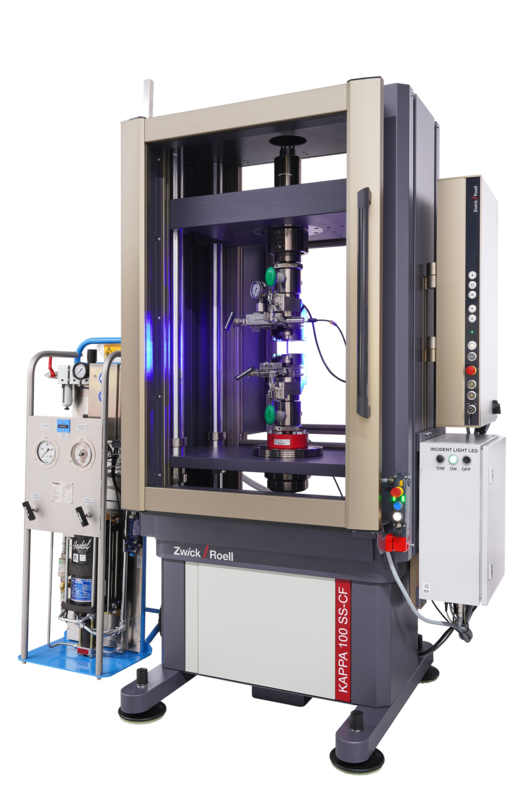
Several factors are crucial for the realistic evaluation of materials under the influence of hydrogen: controlled pressure conditions, precise control of the load speed, and reliable strain measurement even with critical material behavior. The Kappa SS-CF hollow specimen testing system from ZwickRoell was specially developed for creep-fatigue applications and is therefore particularly suitable for slow strain rate tests under hydrogen conditions. The machine enables tests up to 1000 bar and supports very precise control of the load speed. This allows materials to be evaluated under slow, uniform loading – i.e., under conditions that represent typical application scenarios much more realistically than classic tensile tests.
The non-marking videoXtens is used for strain/elongation measurement. The system is particularly suitable for brittle and high-energy specimen fractures, without the operator having to remove the measuring system during the test. The safety concept is also designed for high-pressure hydrogen tests. The test only starts when all safety interlocks are active. The safety cabin and an optical blue light extensometer support a controlled test sequence. Another practical advantage results from the use of compact hollow specimens. The lower hydrogen volume reduces the safety requirements compared to conventional autoclave solutions. This makes it possible to perform tests more efficiently.

Reproducible tests facilitate development and approval processes
A reproducible hydrogen test achieves one thing above all: reliable decisions. Development departments can compare materials more reliably and assess their suitability for hydrogen applications on a more well-founded basis. Quality assurance and testing laboratories benefit from stable testing conditions and results that meet standards. At the same time, risks due to unsuitable materials can be identified earlier. There are also advantages in terms of process: fewer repeat tests, reproducible procedures and better comparability of results support faster approvals and more predictable development processes. Especially in high-pressure applications, realistic testing helps to avoid later failures or safety-critical problems at an early stage.
Conclusion: Realistic hydrogen testing as a decisive factor
Hydrogen applications pose particular challenges for materials. Classic test methods are often not sufficient to reliably reveal critical changes caused by hydrogen.
Slow strain rate tests under realistic pressure conditions help to detect hydrogen embrittlement at an early stage and to evaluate materials in a reliable manner. Precise control, safe test conditions, and reproducible results are crucial.
With the Kappa SS-CF hollow specimen testing system, ZwickRoell supports companies in performing hydrogen tests up to 1000 bar safely and efficiently – as a technical partner for reproducible and standard-compliant testing processes.


Frequently asked questions about hydrogen testing up to 1000 bar
Many hydrogen applications operate under very high pressures. These include, for example, tanks, pipes or valves. Tests up to 1000 bar help to simulate real operating conditions as accurately as possible and to identify material risks at an early stage.
Hydrogen embrittlement describes the change in materials caused by embedded hydrogen. As a result, materials can lose ductility and fracture earlier under load.
SSRT stands for "Slow strain rate test". In this test, a specimen is stretched very slowly in order to make changes in material behavior under the influence of hydrogen visible.
Classic tensile tests are usually performed at higher test speeds. Slow damage mechanisms such as hydrogen embrittlement are therefore often not sufficiently detectable.
Hollow specimens require lower hydrogen volumes. This reduces safety requirements compared to larger test systems, which can make testing more efficient.
ISO 7039 describes test methods for slow strain rate tests under the influence of hydrogen. The goal is a reproducible and comparable evaluation of materials.

