

“Reproducible Test Results are Vital”
To ensure the safe use of hydrogen, materials must be tested under real-world conditions. SCIOFLEX Hydrogen GmbH specializes in precisely that – and has been working with testing technology from ZwickRoell for several years. In the interview, Managing Director Dr. Bernd Schrittesser discusses reproducible test results, safety requirements, the complexity of hydrogen testing systems, and why successful projects require far more than just a high-performance materials testing machine.
Interview
Mr. Schrittesser, you've been working with a ZwickRoell materials testing machine for several years. Looking back on the project with ZwickRoell: What was the biggest challenge in testing materials for hydrogen applications, and how was it resolved?
The biggest challenge was that, at the start, we didn't know for sure – and even today, we still don't know every detail – what tests are actually necessary in which environment. The market is young, dynamic, and highly diverse. There is no one-size-fits-all solution in this field. That's why configuring the machine was a challenging task in itself. ZwickRoell provided excellent support, especially in selecting the necessary components. This allowed us to build a testing system that works in a targeted and reliable manner.
What impressed you most about the collaboration or the testing technology used?
What impressed me most was the professionalism in our collaboration. Response times were quick, questions were addressed directly, and there was a constant effort to find solutions for the customer. I knew this wasn't a standard testing machine that you just turn on and then run test after test. It was more of a collaborative development process. That's precisely why the support provided by ZwickRoell was a key factor in our decision.

What specific requirements does hydrogen testing place on testing systems, and how does the machine used meet these requirements?
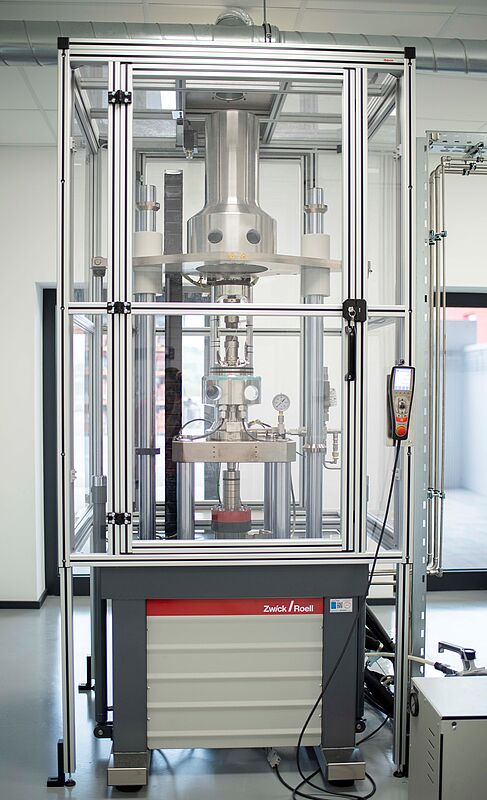
Reproducible results are the most important asset in material characterization. If I test a material and don't get reproducible results, I can't rely on my measured values. Hydrogen testing involves many additional influencing factors: Leak tightness, purge cycles, load cells, extensometers, temperature sensors, and other components in the system. Many components are particularly challenging when exposed to hydrogen. That's why you need a testing system you can trust to handle this task – and that's exactly what we found with ZwickRoell.
Where do you see the biggest differences between traditional materials testing and testing in a hydrogen environment?
For me, traditional materials testing includes, for example, tensile tests, impact tests, or simple fatigue measurements. In the hydrogen environment, we often already find ourselves in the realm of fracture mechanics. The effort required is significantly higher in that area – in terms of specimen preparation, clamping systems, extensometers, and measurement procedures. Hydrogen significantly increases this complexity even further. The gas not only affects the material, but also the entire measuring equipment. This makes the testing process significantly more challenging, especially when it comes to ensuring reproducible results.

What role do precision and reproducibility play in your testing processes?
A central role. Reproducible test results are vital to our survival. As a testing laboratory, we sell results that our customers need to be able to rely on. If customers lose confidence in our test results, we lose our reputation. Therefore, the focus is not on whether a system is more affordable. What matters most is that the results are reliable.
What specific added value does the ZwickRoell solution bring to your daily operations?
The greatest added value lies in reliable test results. It's not primarily about saving energy or making individual process steps particularly fast. What matters most is that we can deliver results our customers can rely on. And it's precisely this reliability that directly impacts our reputation. When a new customer works with us and is impressed by our project management and test results, this often leads to a long-term partnership.
What trends are you currently noticing in materials testing for hydrogen technologies?
We see that in many places across Europe, there is still uncertainty about which tests are actually necessary under hydrogen conditions. Many companies currently don't even conduct tests in a hydrogen atmosphere, believing they can adequately represent processes through simulations or material charts. In our view, the Asian region is significantly more advanced in this regard. There, materials testing in a hydrogen atmosphere is no longer seen as a “nice-to-have” but as an absolute must – regardless of whether it involves plastics, elastomers, or metals.
In your opinion, which developments or standards will particularly shape the industry in the coming years?
But what I clearly see is this: Artificial intelligence will play a bigger role in the future. The goal is to derive new relationships from measurement data. For example, in the future, correlations between different test methods could be identified that are not yet obvious. We are also seeing a growing demand for liquid hydrogen.
Hydrogen testing facilities have stringent requirements for safety and approval. What has been your experience?
It was crucial to involve the relevant authorities and the contracting entity from the very beginning. This helped us clarify requirements early on – such as the explosion protection document, limit values, room concepts, and safety requirements. At the same time, it must be said: Even authorities or experts aren't always familiar with this type of equipment, as they are highly specialized systems. That's why you should communicate early on and address as many potential issues as possible in advance. Nevertheless, unexpected issues can arise – for us, for example, in the area of hydrogen sensors.

Such a system includes more than just the materials testing machine. How complex was the overall integration?
Very involved/time-consuming. A hydrogen testing system isn't a plug-and-play solution. In addition to the materials testing machine, many other components must work together: Pressure generation, compressor, electrical installation, gas detection system, piping, supply system, room preparation, antistatic flooring, ventilation, extraction, explosion protection, and regulatory approval. We had about ten to twelve different companies involved. Even with solid preparation, you should expect it to take extra time after installation for everything to truly function. I would recommend that everyone seek experienced support for this.
How did you handle users and operators?
Users should be involved as early as possible. The better they understand how the machine works, the more confidently they'll operate the system. When there is a sound or a process step starts, the operator should know what's happening and not feel uncertain. We tried to introduce users to the topic gradually. There's always a residual risk, but with knowledge, preparation, and clear procedures, you can do a lot to minimize risks.
What would you recommend to operators before the system is delivered?
You should take the opportunity to familiarize yourself with the system before it's delivered. Go there and ask questions, talk to technicians, observe preliminary tests, understand how to change seals, and familiarize yourself with hydraulics, compressors, autoclaves, and the overall processes. The earlier you get involved and the better you understand the system, the less likely users will later develop reservations or distrust the system.
Is there a situation from the project or a test day that stands out?
A positive example was a project with Japanese customers right here on our premises. Within two days, we tested around 40 plastic specimen under hydrogen conditions. It was impressive – both in terms of the measurement system and the operators, as well as the prepared test sequence. At the same time, day-to-day work consistently reveals just how complex these tests are. New test specifications don't simply mean loading a new program and getting started. It requires calibration, adjustments, and meticulous implementation. Sometimes there are questions that don't yet have a definitive answer because no one has asked them yet.
If you could give advice to a company just starting out in hydrogen testing, what would it be?
You should start with a very thorough literature review. You need to understand which topics are relevant and which requirements actually need to be met. I would also recommend looking into funding opportunities early on, for example, for infrastructure or deep-tech projects. The European market can move slowly at times, and a significant amount of time can pass between initial interest, contract award, and actual measurements. Those who go into this naively quickly underestimate the effort required.

In your opinion, what distinguishes a mere technology provider from a true partner in materials testing?
A true partner doesn't just deliver a machine. They provide support during implementation, remain available for questions, and collaborate with the customer to find solutions. New challenges keep arising, especially with hydrogen testing. That's why you need a partner who doesn't just give standard answers, but is also willing to tackle complex issues. That was precisely the decisive factor for us.


