

Testing Pen Injectors to ISO 11608-1: Automating Processes Closely Aligned with the Life Cycle
When testing pen injectors, it's not enough to evaluate individual functions in isolation. The key is whether the dose setting, preparation, actuation, and delivery remain consistent across repeated uses under defined conditions. Manual testing procedures increase operator influence – such as during priming, dose setting, actuation force, or waiting times – and make it more difficult to analyze the cause when results vary. Automated testing processes reduce these variable steps and create a reliable foundation for design verification and quality assurance testing.
Why design verification and production-related QA have different test objectives
Pen injectors must work reliably in everyday use. Users set a dose, prepare the pen, and initiate the injection. These exact processes must be replicated in the laboratory under defined conditions.
In practice, two testing contexts are often the main focus. Design verification demonstrates that the pen system meets the specified requirements. In quality assurance or release-related tests, manufactured units are evaluated according to defined test plans. Both contexts require reproducible processes, but they don't follow the same evaluation logic.
Especially with reusable pens, it's not just about a single actuation. What matters more is whether repeated use can be simulated in a reproducible way through defined test cycles. To achieve this, preparation, dose setting, actuation, delivery, and documentation must be viewed as a cohesive testing process.
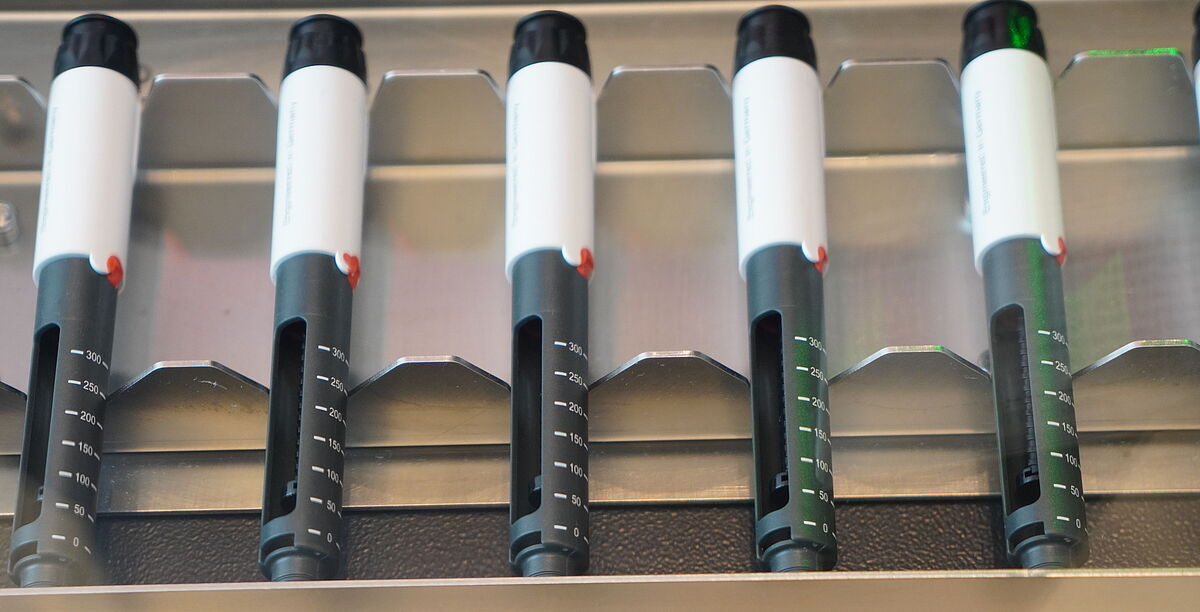
How operator influence causes variability in pen testing
In manual tests, the result doesn't depend solely on the pen. Among other things, operators influence how consistently priming is performed, how quickly a dose is set, the force with which the release button is pressed, and when the measurement starts. These differences may seem minor, but they can lead to systematic variability when testing larger quantities.
The problem becomes particularly evident when results fall outside of expectations. In that case, it's necessary to determine whether the deviation stems from the product or was caused by the test sequence. The greater the operator's influence, the more difficult this root cause analysis becomes. For laboratories, this means more testing, more repetitions, and delayed decisions.
What are the requirements of ISO 11608-1 for testing pen injectors?
ISO 11608-1 outlines requirements and test methods for cannula-based injection systems intended for medical use. This makes it a key normative reference point for pen injectors, especially when assessing dosing accuracy and functional performance. Depending on the item being tested, other parts of the ISO 11608 series may also be relevant, such as those for needles, prefilled containers, or autoinjectors.
For the laboratory process, this means: The standard helps determine which functions and requirements need to be evaluated. However, it does not replace the specific design of a stable testing process. To achieve this, the starting conditions, operator actions, measuring equipment, environmental conditions, and documentation must be defined in a way that ensures results are traceable and reproducible.
Where priming, residual liquid, and environmental conditions affect the dosing test
In practice, it's not just the individual measurement that matters, but the stability of the entire sequence. Priming is a key issue. Before the actual dosing measurement, a defined starting condition must be established. Depending on the pen system and the test plan, this may involve removing air from the fluid path and preparing the needle or the fluid path. Even small differences in this step can affect the subsequent dose measurement.
Residual liquid at the needle tip can also become relevant. If not handled or documented consistently, it can affect the gravimetric evaluation of the delivered quantity. Therefore, the test sequence should clearly define how residual liquid, waiting times, and the transition to measurement are to be handled.
Environmental conditions also come into play. Temperature and humidity can affect measurement sequences, for example, in sensitive weighing operations or due to electrostatic effects. To ensure reproducible results, these influencing variables must be monitored, documented, and considered during evaluation.
Mechanical effects also come into play, such as:
- Recovery behavior of plastic components
- Tolerances in the dosing unit
- Differences in handling
The result in everyday laboratory work: Results vary, tests are repeated, and decisions are delayed.

This is how automation reduces operator influence in pen testing
The key question is not which technology is used, but how to create a stable testing process. To achieve this, three conditions must be met:
- A defined initial state for each test
- Reduced operator influence during preparation, positioning, and actuation
- Clear documentation of the test sequence, measured values, and influencing variables
Automation can bring these points together. Priming, gripping, positioning, dose adjustment, actuation, waiting times, and transfer for measurement can all be performed according to defined parameters. Camera systems can detect the set dose or critical visual features. Weighing technology can record the dispensed quantity. Environmental data such as temperature and humidity can be documented.
ZwickRoell supports these test tasks with system and process solutions where handling, test axes, sensors, software, and documentation are tailored to each specific test plan. What matters is not any single automation component, but rather a repeatable overall process that makes deviations traceable.
Automated priming ensures defined starting conditions for each specimen. This makes it easier to control a common cause of variation in the testing process.
Camera-based systems detect the actual dose set on the pen. This makes it easier to determine whether deviations are caused by the product itself or by an incorrect setting in the test sequence.
The weighing technology used allows even small dosing quantities to be recorded reproducibly. This allows effects like residual liquid at the needle tip to be considered in the evaluation, provided the test plan specifies it.
Additionally, environmental conditions such as temperature and humidity are monitored. This helps identify and classify potential influences on the measurement, such as those caused by electrostatic effects.
Automated handling systems ensure that larger specimen volumes are tested under consistent conditions. Operator influence is reduced, and the testing process remains more stable even over many cycles.
The key factor here is the interaction: A testing process that consistently behaves the same way delivers more reliable and more traceable results.

Benefits for laboratory users
The test sequence becomes more manageable for users. Each specimen goes through the same set of defined steps. This reduces variability caused by operator handling and makes it easier to analyze the cause when a measured value falls outside the expected range. Repeat tests can be reduced because unclear influences in the test sequence occur less frequently.
Benefits for decision-makers and quality managers
For decision-makers, a stable testing process improves predictability. Test rows can be completed with fewer interruptions, results are more easily reproducible, and approval decisions can be based on clearly documented data. Especially when specimen throughput is increasing, automation provides a reliable foundation for scaling testing capacity without proportionally increasing the influence of operators.

Conclusion: Reproducibility determines the validity of the pen test
Testing pen injectors is a complex task where multiple factors work together. Priming, dose setting, actuation, environmental conditions, and mechanical behavior together influence the result. If these factors aren't controlled, variability occurs that is difficult to explain.
Automation doesn't provide a shortcut here; instead, it creates a more stable test frame. It reduces operator influence, standardizes recurring steps, and makes the testing process more traceable. This not only improves the quality of the measurement, but also the reliability of decisions based on this data – from development to quality assurance testing.
How laboratories are preparing for the next step toward stable pen testing
To stabilize existing test sequences, you should first consider the entire process: Specimen handling, priming, dosing settings, measurement chain, environmental conditions, and documentation. Based on this, it's possible to assess which manual steps contribute most significantly to variability and which automation steps offer the greatest benefits in terms of reproducibility and throughput.
Frequently asked questions about automated pen injector testing to ISO 11608-1
The lifecycle testing of pen injectors simulates repeated use under defined test conditions. Steps such as priming, dose setting, and actuation are performed multiple times to evaluate whether relevant functions remain stable over defined test cycles.
ISO 11608-1 serves as a key reference for testing pen injectors, particularly regarding requirements and test methods for needle-based injection systems. Depending on the scope of testing, other parts of the ISO 11608 series may be relevant, such as those for needles, prefilled containers, electronic functions, or autoinjectors. It is crucial to clearly define the specific test object and the applicable part of the standard.
Automated testing reduces operator influence and ensures more reproducible results. This is especially relevant for larger test volumes, as manual processes can lead to variability. Automation makes results more reproducible and simplifies evaluation when deviations occur.
Manual tests are prone to variations in dose setting, priming, handling, actuation, and waiting times. These differences can affect the test result and lead to variability. In practice, this means more repeat tests, delayed decisions, and a more difficult root cause analysis.
Dosing accuracy can be affected by several factors: the priming state, residual liquid on the needle (last drop), mechanical tolerances, actuation, waiting times, and environmental conditions such as temperature and humidity. These influences must be controlled or documented to ensure reliable test results.


