

Seismic Testing of Concrete-Reinforcing Steel to the Standard: Why the Traditional Tensile Test Isn't Enough
For earthquake-resistant structures, the static tensile test for concrete-reinforcing steel isn’t enough. Standards also require low-cycle tensile/compression tests that simulate real earthquake behavior. In practice, however, it is precisely these tests that often become a time and process bottlenecks. Manufacturers who establish them according to standards, reproducibly, and as close as possible to production, accelerate approvals, stabilize quality assurance processes, and maintain planning security.
Why seismic testing makes a difference
During an earthquake, concrete-reinforcing steel is not subjected to constant loads. The material is repeatedly subjected in the tensile and compression direction. It must be able to withstand several load changes, absorb energy, dissipate it in a controlled manner, and undergo plastic deformation without brittle failure.
This behavior is crucial for the load-bearing capacity of the entire structure. A classic static tensile test provides important basic parameters for this, but does not fully represent the actual loading behavior during an earthquake.
For quality assurance and production, this means: Only when the cyclic behavior is properly tested and documented can materials be reliably approved and marketed. Missing or non-reproducible test results can delay approvals and block downstream processes.



Why the classic tensile test alone is not enough
The static tensile test provides important basic characteristics such as yield point and tensile strength. However, it is only part of the solution for assessing seismic behavior.
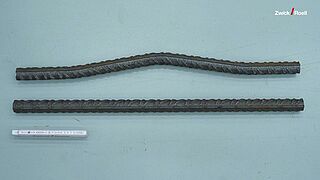
Standards also require a low-cycle test in which the concrete-reinforcing steel is subjected to alternating tensile and compression loads several times – typically:
- Several load cycles (typically 5–10)
- Defined frequencies (approx. 1–3 Hz)
- Plastic deformation (up to +/- 4% of the grip-to-grip separation)
- Visible buckling of the specimen
Only the combination of static and low-cycle testing allows a reliable statement to be made about the material behavior in the event of an earthquake.


Standards provide the framework – implementation is the deciding factor
International standards not only specify that testing is required, but also how it should be performed:
- ISO 15630-1 – mechanical testing of concrete-reinforcing steel
- UNE 36065 – Seismic behavior (Spain)
- PN-H-93220 – Rebar testing (Poland
- SI 739 – Rebar testing (Israel)
These standards specify requirements such as grip-to-grip separation, load cycles, deformation limits, and evaluation rules. This clearly describes the normative framework. However, the real challenge lies in the implementation in everyday laboratory work: The test must be repeatable, safe and comprehensibly documented – even with high forces, large deformations and regular test operation.
Where it gets difficult in practice
The low-cycle earthquake test in particular places high demands on testing technology and procedure:
Technical challenges
- High forces in tensile and compression directions
- Stable cyclic loading at a defined frequency
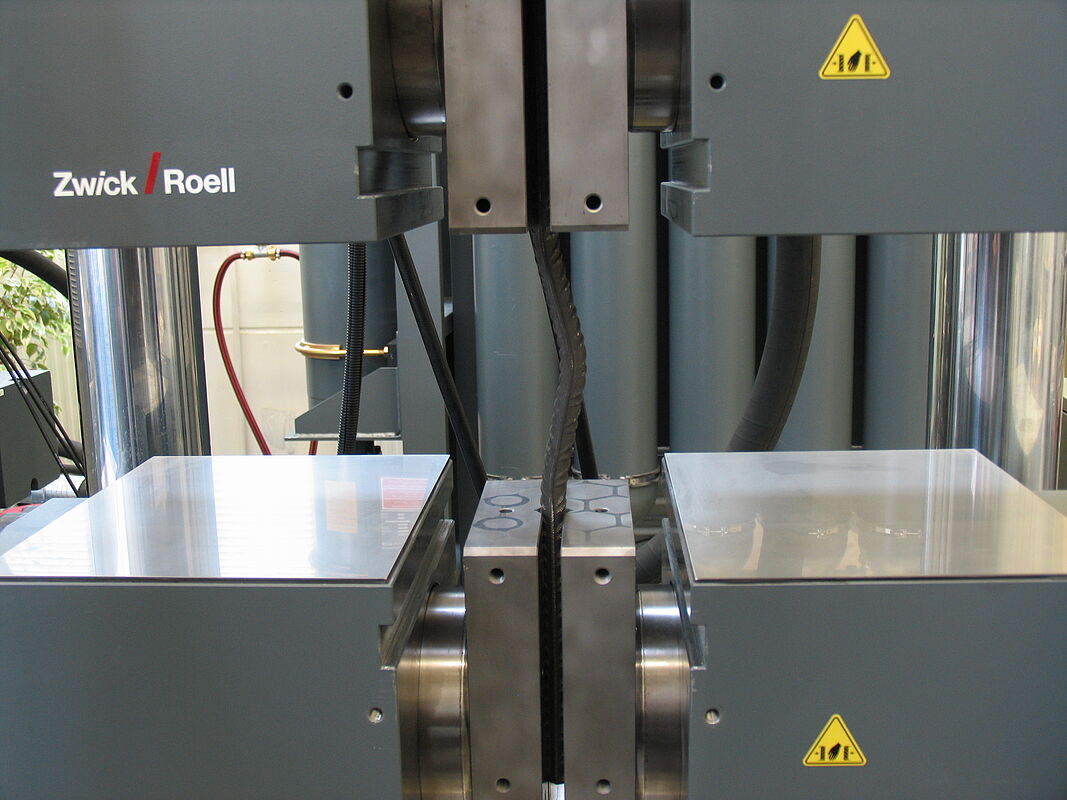
- Secure clamping despite buckling of the specimen
- Reproducible measurement despite large deformations
- Continuous operation without thermal shutdowns
While extensometers are often used in static testing, this is not possible in cyclic testing. Due to the significant buckling of the specimen, the deformation is usually recorded in practice via the travel of the hydraulic actuator.
Process risks
- Sliding or incorrectly clamped specimens
- Invalid tests → Repetitions
- External tests → Transport and waiting times
- Delayed test certificates block approvals
Consequence
The test becomes a limiting factor – for quality assurance and for production.
Why more and more manufacturers are conducting internal testing
For a long time, many companies have outsourced seismic testing to external laboratories or performed it at just a few central locations. This can make sense, but in an ongoing production environment, it often leads to long lead times and limited responsiveness.
If test results are only available after several days or weeks, there is a delay in assessing any deviations. Standardization across multiple plants also becomes more challenging when different testing facilities, procedures, or documentation methods are involved.
Having your own testing infrastructure gives you more control in this regard. Manufacturers can approve materials faster, plan test sequences more effectively, and establish consistent standards across all locations. At the same time, the feedback loop between the laboratory and production improves: Issues are detected earlier, new materials can be evaluated directly in-house, and external waiting times are eliminated. Storage costs can also be reduced if materials are tested and approved more quickly.
How ZwickRoell simulates the seismic testing of concrete-reinforcing steel
ZwickRoell supports manufacturers with testing solutions that combine static and low-cycle tests in a coordinated test arrangement. The goal is a process that meets standards, is reproducible, and is suitable for regular use in laboratories and quality assurance.
Typical system components include:
- Hydraulic testing machines for tensile and compression tests
- Application-specific specimen grips and jaws for standard-compliant grip-to-grip separation
- Testing software (e.g., testXpert III) for control, evaluation, and documentation, which reproducibly controls standard-compliant processes and provides audit-proof documentation
- Tactile (e.g. makroXtens) or Optical extensometer (e.g., videoXtens) for measuring deformation during static testing
- Safety and protective devices
- Optional cooling systems for stable, continuous operation
The focus is not on the machine type, but on the specific test task and a stable, reproducible, and audit-proof testing process.

Tangible improvements in daily operations
Above all, an internally established, standards-compliant seismic test improves predictability. This allows tests to be performed according to standardized guidelines, results to be evaluated in a reproducible manner, and approvals to be issued more quickly.
For quality assurance, this means fewer invalid tests, cleaner documentation, and greater confidence during audits. For production, lead times are shortened because materials don't have to be sent to external testing facilities first. New materials or process changes can be evaluated more quickly, as test results are readily available within the company's own environment.
There is also an advantage when production volumes increase or there are multiple production sites: Uniform testing standards make results more reproducible and reduce the coordination effort between the laboratory, quality assurance, and manufacturing.
Conclusion
Today, seismic testing of concrete-reinforcing steel is an integral part of modern quality assurance. They make it possible to realistically assess the actual load-bearing capacity and ductility of concrete-reinforcing steel – well before the material is used in load-bearing structures. What matters most is not just compliance with standards, but also the reliable implementation of processes within your own environment. Concrete-reinforcing steel manufacturers that establish reproducible low-cycle testing avoid bottlenecks, speed up approvals, and create a solid foundation for safe and reliable buildings. ZwickRoell supports this journey as a long-term technical partner, with a deep understanding of standards, processes, and real-world practicalities.
Frequently asked questions about the seismic testing of concrete-reinforcing steel
Because they simulate the actual alternating tensile and compression behavior during an earthquake, which static tests cannot capture.
Since the specimen buckles during the test, conventional extensometers cannot be used.
Yes – provided that the testing technology, clamping, and test procedure are coordinated to standards and designed to be reproducible.
