Improve your Melt Flow Index Testing with Smarter Extrusion Plastometers
The development of standards and increasing demands for precision have changed the approach to melt flow index testing. The updates to the ASTM D1238:2023 standard are a prime example of this, ushering in a new era of flexibility and automation that requires equally advanced measuring devices.
One of the most significant changes in the standard is the formal approval of force-controlled extrusion plastometers. These systems, which apply the test load via a drive system with a calibrated load cell, offer an accuracy and repeatability of ±0.5%, thereby meeting the requirements of the ASTM E4 standard. This change not only improves measurement accuracy, but also simplifies laboratory operations by eliminating the need for tedious dead-weight systems. However, what truly sets the latest generation of extrusion plastometers apart is their intelligent handling of the preheating phase, a critical step that often determines the accuracy of the entire test.
Smarter preheating, better results
Conventional melt flow index testing have always required a difficult balance:
- Estimating the correct amount of material
- Pre-programming piston movements
- Start the test within the narrow window defined by the standard (time and piston position)


The new approach changes that. Modern force-controlled extrusion plastometers, such as the ZwickRoell Aflow, now has adaptive preheating phase control. Rather than relying on static values, the instrument dynamically adjusts the piston movement to the actual material flow and fill level. Regardless of whether the material has a melt flow rate (MFR) of 0.4 g/10 min or 50 g/10 min, the system ensures that the piston safely and automatically reaches the correct start position.
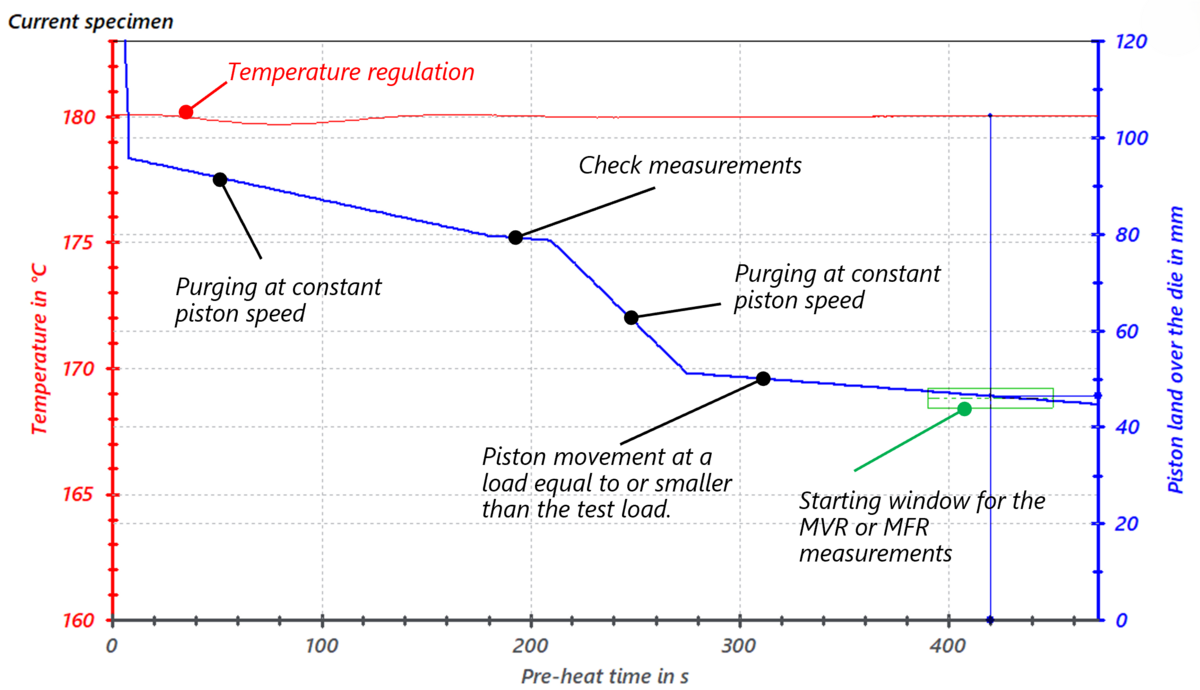
The graphic shows how the device progresses through various stages – control measurements, flushing with constant speed, and controlled piston movement – before entering the measurement window. This level of responsiveness ensures compliance with the standard without requiring operator intervention or estimation.
No pre-testing. No estimating. Only precision.
Another key feature is the automatic parameter control (APC) function. Just before the start window is reached, the extrusion plastometer performs a quick preliminary measurement to determine the optimal piston stroke, either ¼ inch or 1 inch. This eliminates the need for preliminary tests and ensures that each test is both compliant with standards and optimized for accuracy.
This type of automation is a real game-changer. This means no more manual estimates, no risk of incorrect test sequences and no more material waste. For laboratories working with multiple polymer grades and test methods (A, B, C, or D), this results in significant time savings and improved reproducibility.

Designed for the reality of the laboratory
Beyond its technical specifications, what truly sets this extrusion plastometer apart is how it handles the everyday challenges of a melt flow index laboratory. From self-centering hoppers for easy filling to pre-compaction and cleaning at the touch of a button, and a continuously variable load selection from 0.325 kg to 50 kg, every detail is designed for efficiency and repeatability.
In a world where precision, traceability and throughput are non-negotiable, a extrusion plastometer that adapts to your material – not the other way around – is no longer a luxury. It is a necessity.