

Why automate – and when does it make sense for you?
In materials testing, test results should provide reliable information about the material itself – not about operator influence, manual procedures, or differences in laboratory practices. Automated materials testing helps standardize repetitive testing steps, reduce operator influence, and make testing processes more reproducible.
For testing laboratories and quality assurance, this means: less variability, better reproducibility, and more flexibility for qualified personnel to focus on evaluation, analysis, and process improvement.
Why testing laboratories are reaching their limits
Materials testing forms the foundation for quality decisions, material approvals, and product development. Production approvals, delivery dates, and technical decisions in product development all hinge on these results.
At the same time, the requirements on testing laboratories are rising significantly: more tests in less time, stricter requirements for documentation and traceability, a shortage of skilled personnel, and increasing cost pressure.
This situation becomes particularly critical when routine tests tie up a large number of qualified personnel. While experienced operators can effectively control many variables, their availability for more demanding tasks – such as data analysis, material evaluation, or methodological development – is then limited.
The key question is therefore not simply: How can more specimens be tested?
But rather: How test results can be generated to ensure reproducibility, comparability, and process reliability?
Human factor in materials testing
During materials testing, several factors influence the result. In addition to the material itself, the testing machine, specimen preparation, and the operator also play a role. The goal of a sound testing strategy is to minimize all non-material-related influences.
In manual test sequences, variability can arise due to the following factors, among others:
- Different alignment of the specimen
If a specimen is not consistently placed in specimen grips, this can affect the test result. Consistent handling is especially crucial for routine tests that are near-production ready. - Inaccurate cross-section measurement
In many tests, specimen dimensions are directly used to calculate characteristic values. Inaccurate or inconsistently performed measurements can therefore lead to different results. - Influence of hand heat or moisture
Hand heart and moisture can affect a material's fracture behavior. Depending on the material, this can affect characteristic values like yield point or tensile strength. - Different procedures among operators or across locations
When tests are conducted in multiple laboratories, shifts, or locations, different work practices can create additional variability. This makes it harder for quality departments to evaluate results and may require repeat testing.
The result is not just a technical problem. Variability or hard-to-compare results lead to extra work, longer approval processes, and uncertain decision-making in everyday laboratory operations.

How automated testing systems reduce variability
Automated testing systems standardize repetitive process steps: Specimen feed, identification, measuring, testing, evaluation, and documentation. This ensures that test series are conducted under consistent conditions.
Depending on the test task, additional systems can be integrated, such as ID scanners, cross-section measuring devices, hardness testers, roughness measuring devices, thermoregulation, or database connections.
This provides a more robust basis for decision-making in quality assurance. Results can be evaluated with greater confidence, approval processes become more predictable, and qualified laboratory personnel can focus more on analysis, evaluation, and process optimization.
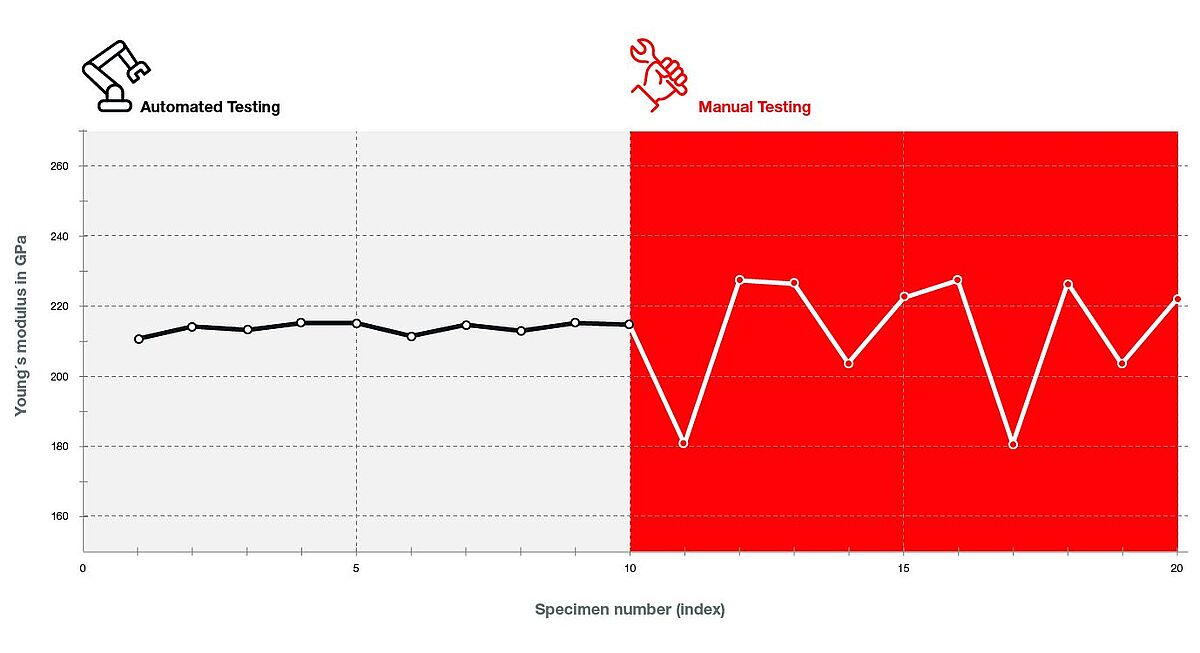


Automation pays off. Measurable and over the long-term.
The decision for automated testing system is often considered based on the initial investment cost. However, the cost-effectiveness over the entire life cycle is crucial. Through increased utilization, more reproducible test results, faster product releases, and greater process reliability, costs can be permanently reduced. The following key figures show where these effects are specifically felt in everyday laboratory work.

Increased laboratory capacity without adding staff

More precise test data creates economic advantages

Get products to customers faster
Automation pays off. The economic impact.
Each individual benefit contributes to the testing laboratory's cost-effectiveness. Overall, this creates measurable added value: existing resources are used more efficiently, decisions are based on more reliable test data, products reach the market faster, and processes run more stably. This turns an investment in automation into a long-term contribution to productivity, quality, and competitiveness.

Flexibility despite automation
A common concern about automated materials testing is that automated systems are too inflexible to handle changing test requirements. However, modern systems must do just that: Adaptability to new materials, revised standards, or additional application.
Automated testing systems like ALEX, roboTest N, and roboTest L make it possible to adapt test sequences to new specimen shapes, modified test sequences, or additional test tasks. The SmartWizard, an assistant for the autoEdition3 automation software, helps operators make these adjustments on their own.
At the same time, manual testing remains an option at all times. This allows special tests, individual specimens, or new methods to be performed independently of the automated process.
How to build an automated testing strategy in the laboratory
An automated testing strategy doesn't begin with selecting a robot; it starts with analyzing the test task. In a first step the existing testing process is considered: from specimen identification, measurement, and feeding to the actual testing, evaluation, and documentation.
Based on this, the appropriate level of automation is determined. For smaller series starting at 10 specimen, the compact ALEX testing solution may be sufficient. For high test volumes, multiple test steps, or additional measuring tasks, the fully automated roboTest R testing system can be a good choice.
The autoEdition3 automation software plays a central role. It controls, regulates, and monitors specimen handling, automated processes for measurements and tests as well as the data storage of test results. As with all ZwickRoell materials testing machines, the test itself is managed by testXpert testing software.
This keeps automation tasks and test management clearly separated: autoEdition3 handles the process flow, while testXpert manages the test itself.


Advantages at a glance:
- Reproducible test results
- Minimal operator influence
- Improved traceability
- Fewer monotonous, routine tasks
- More reliable decision-making
- Faster material approvals
- The key point remains: When operator and machine influences are kept as consistent as possible, the real focus shifts more to the actual test object – the material itself.
When does automated materials testing make sense?
The decision on whether automation is worthwhile should not be made solely based on the size of the laboratory. The specific testing process is crucial: How many specimens are generated regularly? Which test steps are performed repeatedly? What ancillary processes, such as specimen identification, cross-sectional measurement, or documentation, need to be incorporated?
Based on ZwickRoell's experience, around 90 percent of automation pay for themselves within the first two years. The amortization calculator provides an initial indication of whether full automation is worthwhile for a specific testing application.
However, a thorough analysis of the payback period remains crucial. This is because cost-effectiveness depends, among other things, on the daily number of specimens, the testing time per specimen, the degree of automation, personnel costs, working hours, shift models, existing testing machines, and potential retrofits.
For a reliable evaluation, ZwickRoell offers a customized payback calculation based on specific testing needs.

Ready for the future: Buy testing machines today, automate tomorrow
Which products tomorrow’s market will demand and what the corresponding tests will look like is difficult to predict today. New materials, changed standards or additional applications can mean that testing laboratories have to adapt or expand their testing processes.
One advantage of modular ZwickRoell testing systems is that they can be prepared for future requirements. Even manually operated testing machines can be later expanded with automation if necessary. If an existing ZwickRoell machine is subsequently automated, up to 80 percent of the existing components can be reused.
This creates investment security: Existing equipment remains usable, while the degree of automation can be adapted to new test volumes, process requirements or applications. This means that the materials testing machine is not only procured for today's test task, but remains prepared for future expansions from day one.
Conclusion: Automation helps shift the focus back to the material
The automation of materials testing is far more than a means of reducing manual work steps. It helps testing laboratories minimize operator influence, make testing processes more reproducible, and use existing resources more efficiently.
At the same time, the development of modern automation solutions shows that automation is no longer reserved exclusively for large testing laboratories. Different configuration levels are available, from the entry-level system for standardized routine tests to the fully integrated testing system.
In the end, the focus is on the actual goal of every materials test: reliable characteristic values where, as far as possible, only one factor counts – the material itself.


