
Breaking Ground in Materials Testing: How Artificial Intelligence (AI) Revolutionizes Hole Expansion Tests to ISO 16630
The demands on modern sheet metal materials are constantly increasing. In the automotive, energy, and aerospace industries, sheet metal must not only be lightweight and stable, but also reliably formable – without causing edge cracks. To be able to evaluate this susceptibility to cracking, the hole expansion test (HET) to ISO 16630 has become the standard method. ZwickRoell takes a step further with an innovative solution: AI automatically detects cracks in real time – integrated in the sheet metal testing machine (BUP).

What is a hole expansion test? And why is it crucial for sheet metal forming?
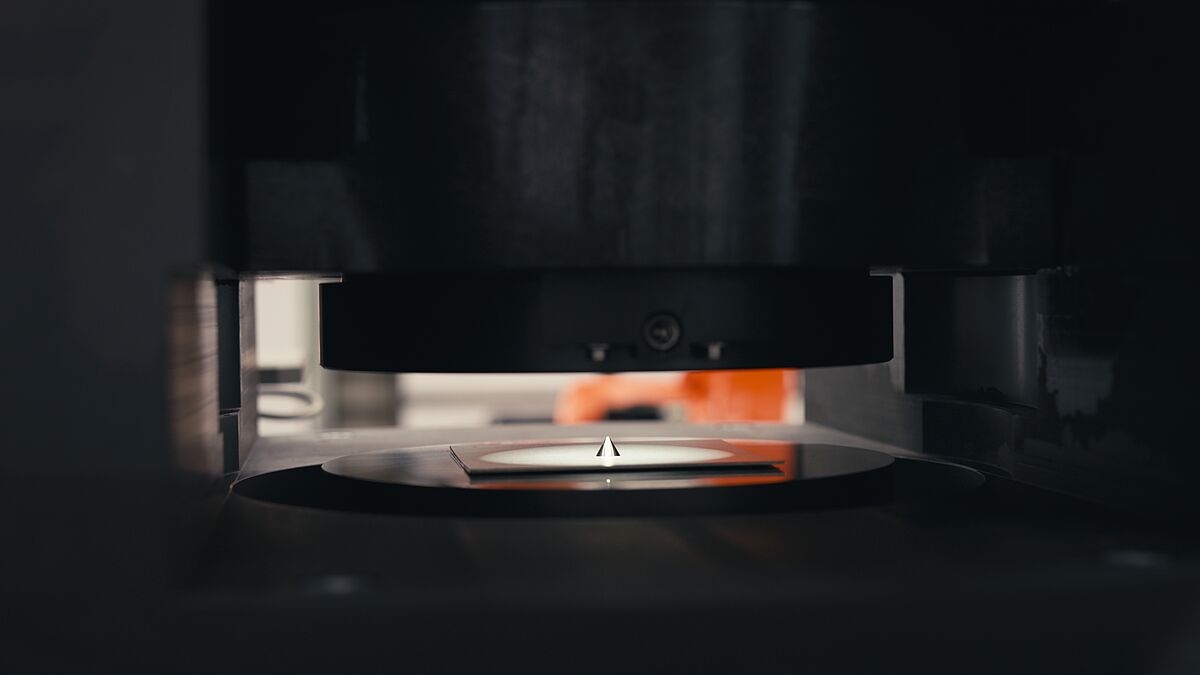
The test on the sheet metal testing machine (BUP) starts with a 10 mm diameter hole punched in a sheet metal specimen. This hole is widened with a conical punch (60°) until a continuous crack appears. The goal is to determine the hole expansion ratio (λ), which, among other things, describes the ductility of the sheet metal edge. The challenge is accurately detecting the first continuous crack. Manual methods are error-prone and highly dependent on the individual operator. Traditional image processing algorithms offer greater consistency, but they reach their limits when dealing with a wide variety of materials. And this is exactly where AI comes in.
While traditional, rule-based image processing algorithms offer greater consistency, they necessitate the adjustment of specific parameters for each type of material. For new specimen types, the appropriate parameter set must first be determined, which is time-consuming. When changing the specimen, it’s important to ensure the correct parameter set is selected for the specimen. AI-based crack detection eliminates these challenges: It reliably detects cracks without manual tuning and automatically adapts to different materials.


Detecting edge cracks: That's why traditional methods are reaching their limits.
Manual crack detection requires the operator’s full concentration and experience. The defect rate increases, especially at higher test speeds. While traditional industrial image processing is more consistent, it often lacks the flexibility needed for new or complex materials. The result: late or incorrect crack detection. And that’s exactly what sometimes leads to inaccurate test results and unwanted repetitions.

Real-time crack detection with AI: How ZwickRoell's neural network works
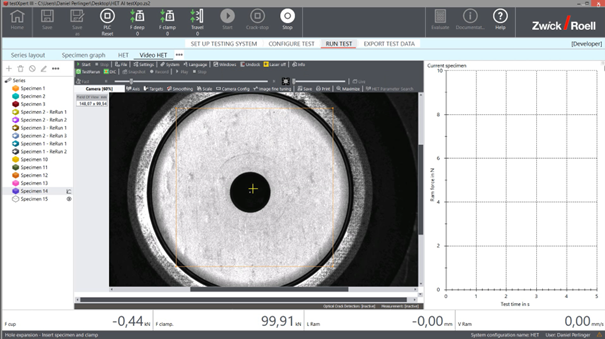
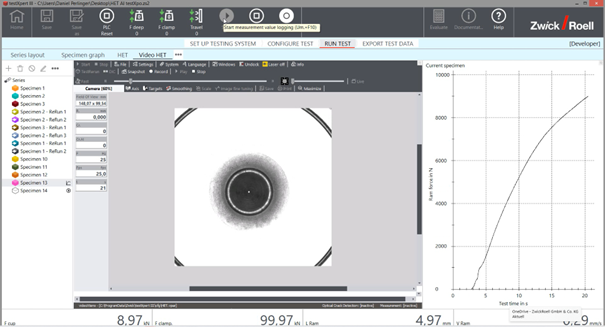
ZwickRoell has integrated a specially developed neural network into its testXpert testing software. This detects cracks in real time – directly during the test. Image processing takes just 50 milliseconds per image, even on a standard test computer.

The database for reliable AI results: 657,000 images, 2,700 specimen
The AI from ZwickRoell was trained using over 657,000 images from 2,700 specimen. The data is obtained from customer projects, internal tests and commissioning. The crack annotations strictly adhere to ISO 16630, ensuring standard conformity. And the results are clear: The AI reliably detects cracks in known materials with 99% accuracy, and in new materials with 98-99% accuracy.
Automated sheet metal testing with BUP – where precision meets efficiency
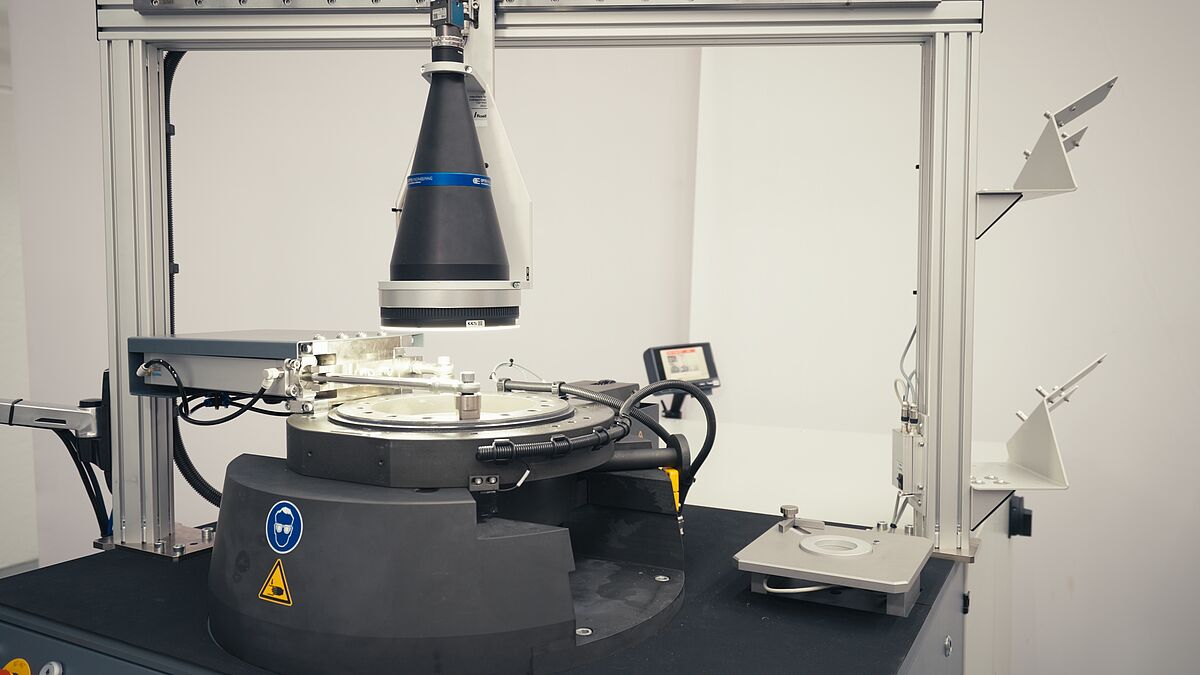
The BUP (sheet metal testing machine) from ZwickRoell is the ideal platform for hole expansion tests. It was specifically designed for deformation tests on sheet metal and offers a variety of functions to make the testing process more efficient and safer. A particular highlight: automated specimen handling. With a magazine that can hold up to 100 specimen and integrated 2D code detection, tests are performed in "Night Shift" mode – without operator intervention. This saves time and reduces the sources of errors. The BUP is also fully compatible with the videoXtens extensometer, which integrates AI crack detection. This creates a seamless, automated testing process – from specimen identification to results documentation.
Flexible for new materials: This way AI remains adaptive to retraining
Another advantage of the AI solution is its ability to be retrained. When testing new, exotic materials, the AI can be retrained with additional data – either on-site at the customer’s location or in the cloud. Starting in 2026, ZwickRoell will offer a special retraining program that allows customers to develop their own models based on specific materials.
Conclusion: More quality, less effort – that's why AI and BUP are redefining materials testing
The hole expansion test with AI crack detection represents a significant advancement in materials testing. The combination of intelligent software and the powerful BUP testing machine delivers a new level of test result quality: precise, reproducible and independent of the operator. AI reliably detects cracks in real time, saving time and materials while reducing the impact of human error. At the same time, the BUP is a robust testing system that can be automated and seamlessly integrated into modern production and quality assurance processes. With the ability to further train the AI, the system is also future-proof and flexible for new materials and requirements. Companies that rely on this technology invest not only in better test results, but also in efficiency, safety and innovation.


