

Methods for characterization of slow crack growth
Pipes made of polyethylene such as PE80, PE100 or the improved PE100RC display differing levels of sensitivity to slow crack growth. The terms "Environmental Stress Cracking" (ESC) and "Slow Crack Growth" (SCG) are used to describe this behavior. A failure of this type takes place well below the yield stress of the material and is therefore of enormous significance in the long-term assessment of the mechanical properties of the material.
Visible in the crack front are what are known as fibrils, which display time-dependent failure under load. A range of tests has evolved to characterize this mechanism. These include:
- Creep tests with constant internal pressure: ISO 1167, ISO 9080
- Slow crack growth on notched pipes: ISO 13479
- Full notch creep test (FNCT): ISO 16770
- Polyethylene notch tensile (PENT) test: ASTM F1473, ISO 16241
- Bent strip ESCR test: ASTM D1693
- Cone test method: ISO 13480
For defined acceleration the test is performed with a sharp initial notch, at raised temperature and in a liquid with an accelerant effect, usuallyIgepal® CO-630.
Recent research has generated additional test methods which allow good assessment of ECG properties with very short test duration. For the user these methods mean a significant reduction in test expenditure combined with fast test result availability.
The following standards were published in 2015:
- ISO 18488 Polyethylene (PE) materials for piping systems -- Determination of Strain Hardening Modulus in relation to slow crack growth
- ISO 18489 Polyethylene (PE) materials for piping systems -- Determination of resistance to slow crack growth under cyclic loading -- Cracked Round Bar test method
Determination of strain hardening modulus to ISO 18488
The specimen shape used for this test method is a small dumbbell with relatively wide shoulders; measurement is performed under tensile loading. PE strain hardening modulus is measured at a temperature of 80°C with a deformation ratio λ between 8 and 12. This corresponds to a strain interval of 400% between the 700% and 1100% strain points. In this range the polymer is already fully stretched, allowing the deformation behavior of the fibrils to be measured. The diagram for true stress over neo-Hookean strain (λ² - 1/λ) shows a virtually linear gradient for PE. This gradient is described by a linear equation in the form σ true = Gp (λ² - 1/λ) +C. Gp is the gradient factor of the lines.

Related Products ISO 18488
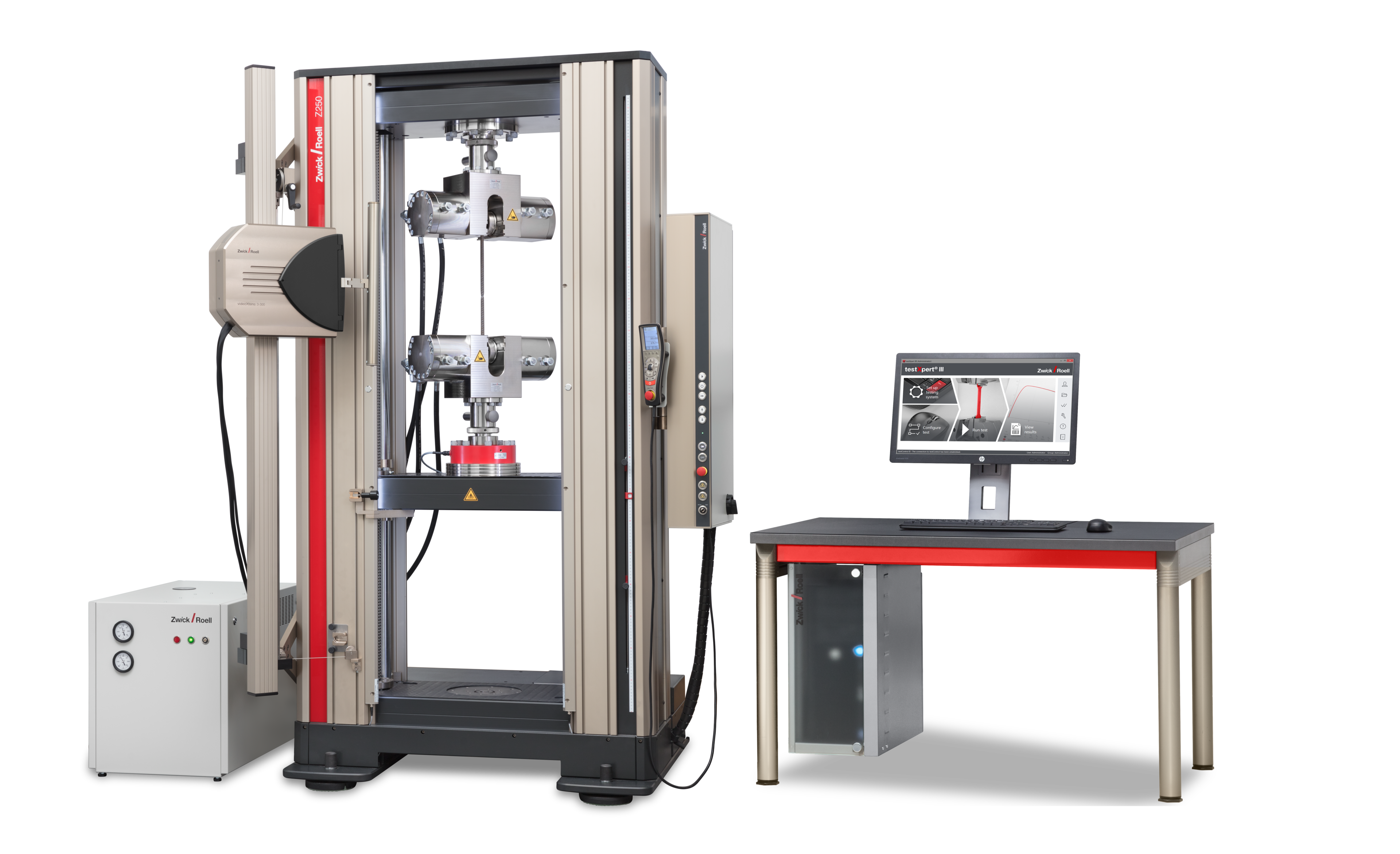
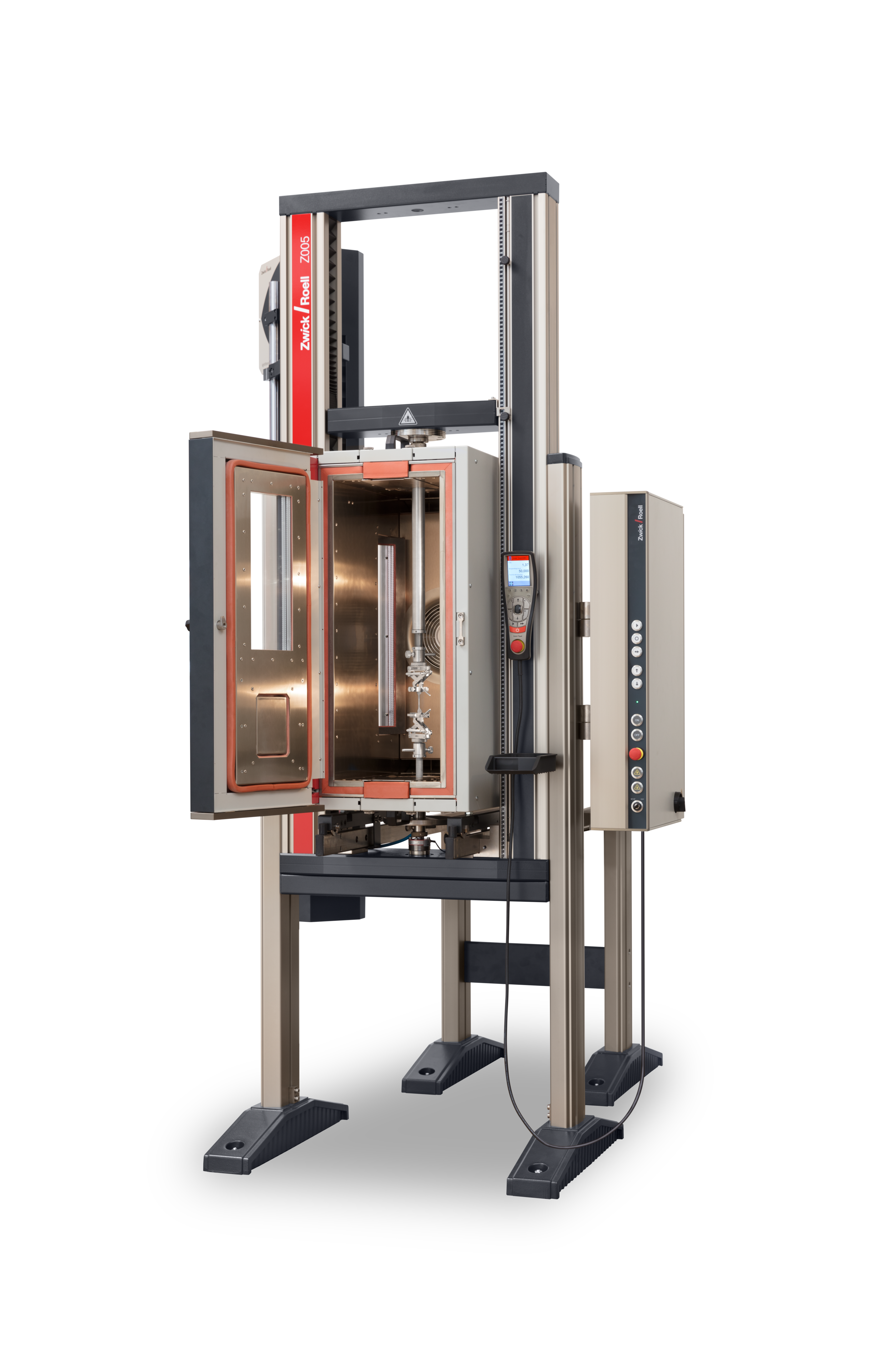
Strain hardening modulus measurement to ISO 18488 requires an electromechanical testing machine equipped for example as below:
- Z005 AllroundLine (or larger) testing machine
- Temperature chamber which permits a tensile clamp movement of at least 360 mm
- Mechanical or optical extension measurement system, e.g. ZwickRoell videoXtens
- Parallel-clamping specimen grips, e.g. pneumatic parallel grips testXpert standard test program to ISO 18488 displaying "true stress" over neo-Hookean strain, as well as "true stress" over deformation ratio λ and calculation of GP and check of regression coefficient r
Determination of the resistance against slow crack growth under cyclic loading, to ISO 18489
This method uses a cylindrical specimen, in which a rotating initial notch has been inserted. Cyclic loading with constant force amplitude is applied to this specimen. The force amplitude is selected in order to allow slow crack growth.
The test result is the number of cycles until specimen failure and is displayed as a function of the applied stress Δσ0 at the initial crack length.
Test duration is kept to a minimum with the new test method to ISO 18489. It should be reduced especially at the height of the cyclic loading depending on the specimen geometry. Another advantage of this test method is that it can be performed at room temperature so that the polymer structure of the specimen is maintained.

Related products ISO 18489
ZwickRoell has developed the LTM testing machine with patented linear drive technology and force-controlled pneumatic grips for testing to ISO 18489.
- The loading cycles are applied precisely and uniformly. In addition to force control, other control modes are possible, such as peak value control, piston travel control or direct
- Strain control via a connected extensometer.
- The force-controlled specimen grips reliably prevent overloading of the specimen during the gripping process.
- The wear-free drive and low power consumption ensure low ongoing operating costs.
- The testXpert III software controls the entire test sequence and produces the results in a format that is clear and exportable.
This makes ZwickRoell's LTM ideal for efficiently testing the resistance to slow crack growth according to ISO 18489.


Take advantage of the leading testing software in materials testing
ZwickRoell’s testXpert testing software offers:
- Simple operation: start testing right away and be a testXpert while maintaining maximum safety.
- Reliable and efficient testing: benefit from reliable test results and maximum testing efficiency.
- Flexible integration: testXpert is the optimal solution for all of your applications and processes—simply put, a more effective workflow.
- Future-proof design: testing software for the entire life cycle, ready for your future test tasks!
