
Dynamic-mechanical analysis (DMA, DMTA)
Dynamic mechanical analysis (DMA) characterizes the viscoelastic properties of materials across a specified frequency and temperature range, making it highly informative for understanding the behavior of polymeric materials. For the measurement, a specimen or component is subjected to a free or forced sinusoidal oscillation amplitude, with either displacement or force control.
Characteristic value Testing solutions Video Automation Standards Downloads
What does dynamic mechanical analysis (DMA) determine?
The following fundamental material properties are determined from the time sequence of the force and deformation measurements:
- The storage modulus, which describes elastic behavior
- The loss modulus, which describes the viscose behavior
- The loss factor, tan δ, which describes the ratio of elastic to viscous behavior.
- The complex modulus, which describes viscoelastic behavior as a vector on the complex number plane.
Which testing systems are suitable for dynamic mechanical analysis?
The measurement is typically a short-term measurement with minimal deformation. Accordingly, the applied forces during material characterization measurements on standard specimens are minimal.
Higher forces occur when measuring larger and complete components, such as dampers, tires, belts or engine mounts.
By selecting the appropriate type of load, both normal stress and shear stress can be applied. Typical type of loads include:
- Compression loading
- Tensile loading
- Flexural loading
- Fatigue loading
- Torsion loading
whereby the oscillation can take place on one side with a basic load or also as an alternating load.
Servohydraulic and electrodynamic testing systems such as the ZwickRoell LTM testing machine are particularly suitable for dynamic mechanical analysis of components. Its high-precision displacement measuring system, pronounced frame rigidity and oil-free drive make it ideal for DMA testing. Thanks to its quiet drive, the LTM is particularly suitable for use in the laboratory. The space-saving design and flexible positioning of the tC II electronics, combined with the remote control for precise test fixture, complete the overall concept.
The LTM’s performance range optimally covers the test frequencies required by the standards, ranging from 0.01 to 100 Hz. A wide range of test tools offer maximum flexibility: from compression platens to flexure test kits with freely mounted or fixed specimens, to shear force devices and specimen grips for secure, fixed clamping. This allows for the reliable and efficient representation of a wide variety of test tasks.

Dynamic mechanical thermal analysis (DMTA)
By repeating the measurement in a wide temperature range (DMTA), further characteristic values, such as the glass transition temperature, can be determined or conclusions can be drawn about the degree of cross linking in curable plastics or elastomers.
In some standards, variable temperature is required during the test. For these tests, ZwickRoell offers various temperature chambers that guarantee the perfect solution for every application.

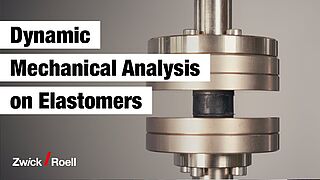

Fully automated testing system for DMA measurements and the determination of dynamic properties of rubber/elastomers
Dynamic mechanical analyses provide insight into the viscoelastic properties of polymeric materials, the dynamic behavior of rubber and other characteristics such as the effect of fillers or the degree of cross linking in rubber. Because the measurements are quick and easy to perform, they are suitable for quality assurance.
The production of high-quality elastomer components relies on many details. Even if the compound’s formulation was established during product development, the distribution of fillers and additives, along with all parameters influencing cross linking during the vulcanization process, remains crucial.
Measuring dynamic properties at a fixed frequency and temperature provides clarity and ensures consistent product quality. To ensure continuous monitoring of the production process, the testing system was equipped with an automatic specimen feeder, enabling both uniform preconditioning and a continuous testing process.
The LTM electrodynamic testing machine combined with the lightweight robot roboTest N is ideal for demanding material and components testing. The machine is particularly suitable for analysis of rubber and provides a high-performance solution for research, development and quality assurance. The LTM is based on an electromagnetic linear drive and is designed for both dynamic and static materials testing. Typical applications include fatigue and endurance tests.
Rubber and elastomers show time-dependent deformations when they are subjected to load. In conjunction with the testXpert R software, the LTM 1 enables precise analysis of these properties, for example through frequency and temperature sweeps. Parameters such as the storage and loss modulus, loss factor (tan δ) and dynamic stiffness are determined.
Automation with roboTest N
For laboratories with high throughput, the LTM can optionally be automated with the lightweight robot roboTest N. The system takes over specimen feeding, positioning and gripping procedure, and is suitable for tensile, compression and flexure tests. Up to 200 specimens can be tested autonomously, including additional stations such as cross-sectional measurement or ID scanning.
Intuitive configuration with testXpert
The testXpert software with an integrated sequencer, enables intuitive configuration of complex test sequences. Standard functions such as ramps, sine or rectangular profiles as well as automated temperature and frequency changes are included. Control takes place via force, elongation or position control, supplemented by peak value control. All test parameters and results are stored in a tamper-proof database and can also be exported.


Standards for dynamic mechanical analysis
Various test methods with forced vibrations for plastics, composites, rubber and elastomers are available in the ISO and ASTM standards series.
| Material | Standard | Description |
|---|---|---|
| Plastics | ISO 6721-1 | Basics and general principles for measuring the viscoelastic behavior of solid plastics |
| Plastics | ISO 6721-4 | Determination of dynamic mechanical properties - tensile vibration |
| Plastics | ISO 6721-5 | Determination of dynamic mechanical properties - flexure vibration |
| Plastics | ISO 6721-6 | Determination of dynamic mechanical properties - shear vibration |
| Plastics | ISO 6721-11 | Determination of dynamic mechanical properties - glass transition temperature |
| Plastics | ISO 6721-12 | Determination of dynamic mechanical properties - pressure vibration |
| Plastics | ASTM D5023 | Test to determine the dynamic-mechanical behavior of plastics using non-resonant machines at frequencies from 0.01 to 100 Hz in a 3-point flexure tests |
| Plastics | ASTM D5024 | A test to determine the dynamic-mechanical behavior of plastics, conducted as a compression test where round specimens are cyclically loaded between rigid plates within their elastic range, and the temperature is increased in a controlled manner. |
| Plastics | ASTM D5026 | A test to determine the dynamic-mechanical behavior of plastics, conducted as a tensile test, where flat specimens are stretched between clamping devices while the temperature is increased in a controlled manner. |
| Plastics | ASTM D5418 | A test to determine the dynamic-mechanical behavior of plastics, conducted as a flexure test, where a easily clamped bending beam is cyclically loaded within the material’s elastic range at frequencies of 0.01–100 Hz, while the temperature is either kept constant or varied in a controlled manner. |
| Composites | ASTM D7028 | A test to determine the dynamic-mechanical behavior of polymer matrix composite material, conducted as a flexure test, where the cuboid specimens are cyclically tested in a 3-point flexure or a fixed flexure test kit at 1 Hz, with a constant strain amplitude in the linear-viscoelastic range, while the temperature is increased from ambient temperature throughout the test. |
| Rubber | ISO 4664-1 | Determination of the dynamic properties of vulcanized or thermoplastic rubber |
| Rubber | ISO 4664-3 | Determination of the dynamic properties - glass transition temperature |
| Rubber/elastomers | ASTM D5992 | A test to determine the dynamic-mechanical behavior of rubber and elastomers, in which specimens are subjected to shear, compression, tension, flexure or torsion under dynamic, free or forced resonance stimulus, at ambient temperatures ranging from −70 °C to +200 °C. |

