
High-temperature creep test up to +1,500°C
Case Study
- Customer:Otto-von-Guericke-Universität Magdeburg
- Location: Magdeburg, Germany
- Industry:Research Institute & Academia
- Topic:Mechanical characterization of innovative high-temperature materials

February 2026
The development of modern high-temperature materials is a key component of technical progress in energy and aerospace engineering. The mechanical testing of high-temperature materials places high demands on testing technology and measuring systems. At temperatures up to +1,500°C, oxidation, temperature gradients and environmental influences can significantly affect measurement results. At the same time, implementing modern material concepts often requires very small specimen geometries, very low test speeds and fatigue and creep tests. With this in mind, the Chair of High Temperature Materials at the Institute for Materials, Technologies and Mechanics (IWTM) of the Otto-von-Guericke-Universität Magdeburg has been planning to acquire a suitable materials testing machine since 2019.
Otto-von-Guericke-Universität Magdeburg
The Otto-von-Guericke-Universität Magdeburg (OVGU) is a public university in Saxony-Anhalt, Germany, established in 1993 through the merger of several universities. It encompasses a wide range of teaching and research across engineering, natural sciences, medicine, business and the humanities.
The Professorship of High Temperature Materials is located within this structure at the Institute for Materials, Technologies and Mechanics (IWTM). As a specialized research unit, the working group focuses on the research, development, characterization and evaluation of materials for demanding applications. A key focus is on mechanical and thermomechanical testing at elevated temperatures.
The laboratories offer a comprehensive testing infrastructure and modern methods for characterizing metallic and intermetallic materials, as well as material composites. A key research focus is the investigation of innovative high-temperature materials, such as those based on refractory metals, and the determination of their mechanical characteristic values at temperatures up to +1,500°C.
The experimental work is complemented by accompanying analytics, modeling and simulation. Based on this, the OVGU provides robust research and testing services, as well as opportunities for collaboration between industry and research.


The requirements for testing technology
The Chair of High Temperature Materials at the Institute for Materials, Technologies and Mechanics (IWTM) of the Otto-von-Guericke-Universität Magdeburg investigates materials for demanding applications, in particular in the energy and high-temperature range. Therefore, for experimental basic research, there was a need for a testing system that enables time- and temperature-dependent tests under controlled atmospheric conditions – reliably, reproducibly and in compliance with standards.
Since the establishment of the Professorship of High Temperature Materials in October 2019, plans have been made to purchase a new creep testing machine for testing high-temperature materials up to +1,500°C.
The goal was to develop a testing system for tensile, compression and flexure tests, as well as for creep tests, at temperatures up to +1,500°C. In addition to a wide temperature range, stable force and strain control at very low deformation speeds, as well as precise strain measurement on small specimens, were required.
Additionally, the tests should be performed in compliance with standards to ensure reproducibility with international research results and industrial testing standards. The system should allow for testing in both high vacuum and inert gas environments to specifically minimize oxidation and environmental influences.
The ZwickRoell solution
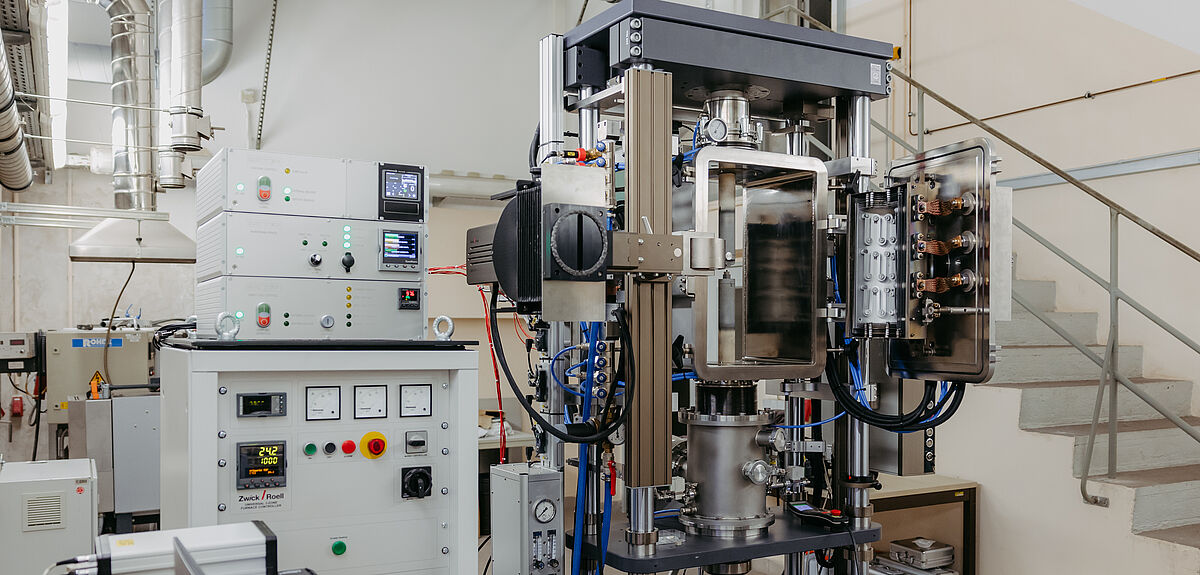
To meet these requirements, the Chair selected the Electromechanical creep test machine Kappa 100 SS-CF with an integrated high-temperature vacuum chamber. The system is specifically designed to study material behavior as it changes with time, temperature, and load, and is suitable for both research and quality-related test tasks.
The Kappa 100 SS-CF has a highly rigid, four-column test frame with a backlash-free central lead screw drive. This design ensures precise axial force application and minimizes interference with the specimen. The system’s maximum nominal force is 100 kN. However, for high-resolution measurements, a 50 kN load cell is used directly in the vacuum chamber, which reduces the influence of friction and temperature on the force measurement.
A key element of the system is the integrated high-temperature vacuum chamber with tungsten heating elements. The 3-zone furnace allows for testing at temperatures up to +1,500°C and ensures a uniform temperature distribution in the specimen area. Tests can be conducted in both high vacuum and inert gas, which specifically minimizes oxidation and environmental influences.
Accurate measurement in extreme conditions
An optical extensometer is used to record specimen deformation without contact. The laserXtens 1-32 HP/TZ allows for high-resolution measurement of even the smallest elongation, with initial gauge lengths ranging from 1.5 to 25 mm. It meets accuracy grade 0.5 to EN ISO 9513, without attaching gauge marks to the specimen.
Because there is no mechanical contact with the specimen, the material remains unaffected even at high temperatures. This is particularly advantageous for brittle materials or very small specimens. If laser reflection is limited or during long-term creep tests, the integrated functionality of the videoXtens HP/TZ can be used as an alternative. However, the necessary marking of the specimen limits testing to a maximum temperature of +1,400°C.
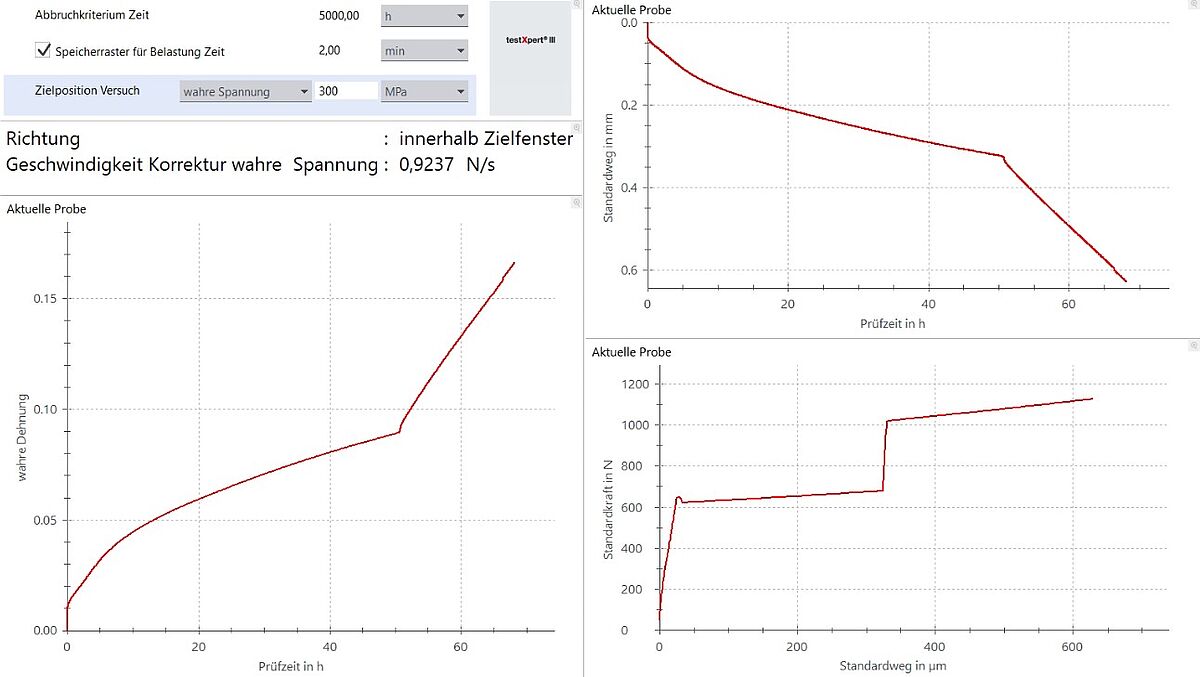
The modular measurement and control electronics of the Kappa 100 SS-CF enable force- and strain-controlled tests with high control stability. Even very low test speeds, in the µm/h range, can be reliably achieved.

Compliant testing
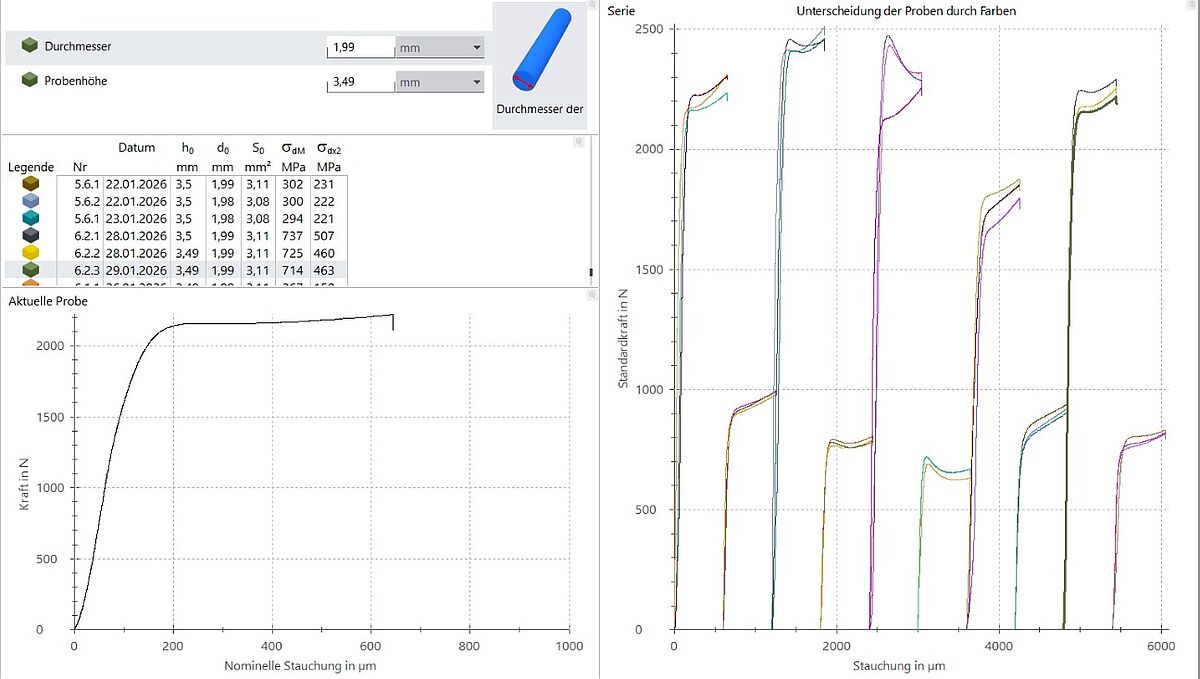
At the Chair of High Temperature Materials, the facility is used to perform tensile, compression and flexure tests at temperatures up to +1,500°C. Creep tests are performed compliant to ISO 204 and ASTM E139. The force measurements is designed to DIN EN ISO 7500-1. This ensures a high degree of reproducibility of the test results with international research and industry standards.

“The Kappa 100 SS-CF has become a key element in the research and development of new high-temperature materials. Characterizing materials at test temperatures up to 1,500°C, either under inert gas or in a vacuum, allows us to gain a deeper understanding of the deformation mechanisms of both established and innovative materials under extreme loading conditions within the application-relevant temperature range.”
Prof. Georg Hasemann, Otto-von-Guericke-Universität Magdeburg
Results and Benefits
The commissioning of the Kappa 100 SS-CF has significantly expanded the materials testing capabilities of the Professorship of High Temperature Materials. The system combines high temperature resistance with precise force and strain measurement, enabling the standard-compliant performance of demanding high-temperature tests. This provides a powerful and future-proof platform for the mechanical characterization of modern high-temperature materials. The professorship thus contributes to the development of new materials for energy and aerospace technology.
Through reproducible simulations of real-world conditions, microstructure-property relationships can be thoroughly analyzed, and reliable mechanical properties can be determined. The creep testing facility also strengthens the position of Otto-von-Guericke-Universität Magdeburg as a competent partner for industry and research. The test results obtained are directly applicable to industrial applications, such as the design of components exposed to high temperatures or the qualification of new material concepts.