
ISO 4074 Testing of Condoms
ISO 4074 ensures the necessary safety and performance of condoms as a means of contraception and protection. It defines clear requirements and test methods that guarantee high mechanical strength, such as tear resistance, elasticity, and resistance to burst pressure and volume. The standard also addresses the requirement that condoms are leak-proof, durable, and correctly packaged.
The following content explains the essential aspects of determining the tear strength and strain at tear (i.e., force and elongation at break) according to ISO 4074 Annex J. However, for tests compliant with ISO 4074, obtaining the complete standard is mandatory.
ISO 4074 Specimen preparation
Before cutting, the condom may be dusted with an absorbent powder, such as talc, or degreased with a talc-isopropanol suspension to prevent it from sticking.
A specimen is cut from the flattened condom using a cutting tool consisting of two parallel blades (spacing: 20 ± 0.1 mm) (at least 80 mm from the open, unstructured end), resulting in a ring-shaped specimen. Care must be taken to ensure that the specimen has no nicks or other edge defects.
ZwickRoell offers suitable cutting presses for the standard-compliant production of specimens.
Running a test to ISO 4074
The test is performed under controlled conditions at a temperature of 25 ± 5°C, with the actual test temperature being recorded with an accuracy of 0.5°C. The specimen is placed over the rollers of the tensile testing machine and stretched until it tears/breaks. When it tears, the tear strength (force) must be recorded with an accuracy of 0.5 N and the distance between the centers of the rollers to the nearest millimeter.
The rollers must rotate during the test to prevent friction-related defects at the specimen's contact points. The rollers are connected to the crosshead movement via a toothed belt.
As a result, the strain at tear [elongation at break (E)] is calculated as a percentage for each test piece using the following equation:
𝐸 = ((𝑙1 + 2𝑑 − 𝑙2)/𝑙2) × 100
, where:
- l1 is the length of the specimen (in mm) that touches the rollers (47 mm for rollers with a diameter of 15 mm)
- d is the distance between the centers of the rollers (in mm)
- l2 the circumference of the specimen before testing (in mm)
The result should be rounded to 10%.


Testing systems for testing to ISO 4074
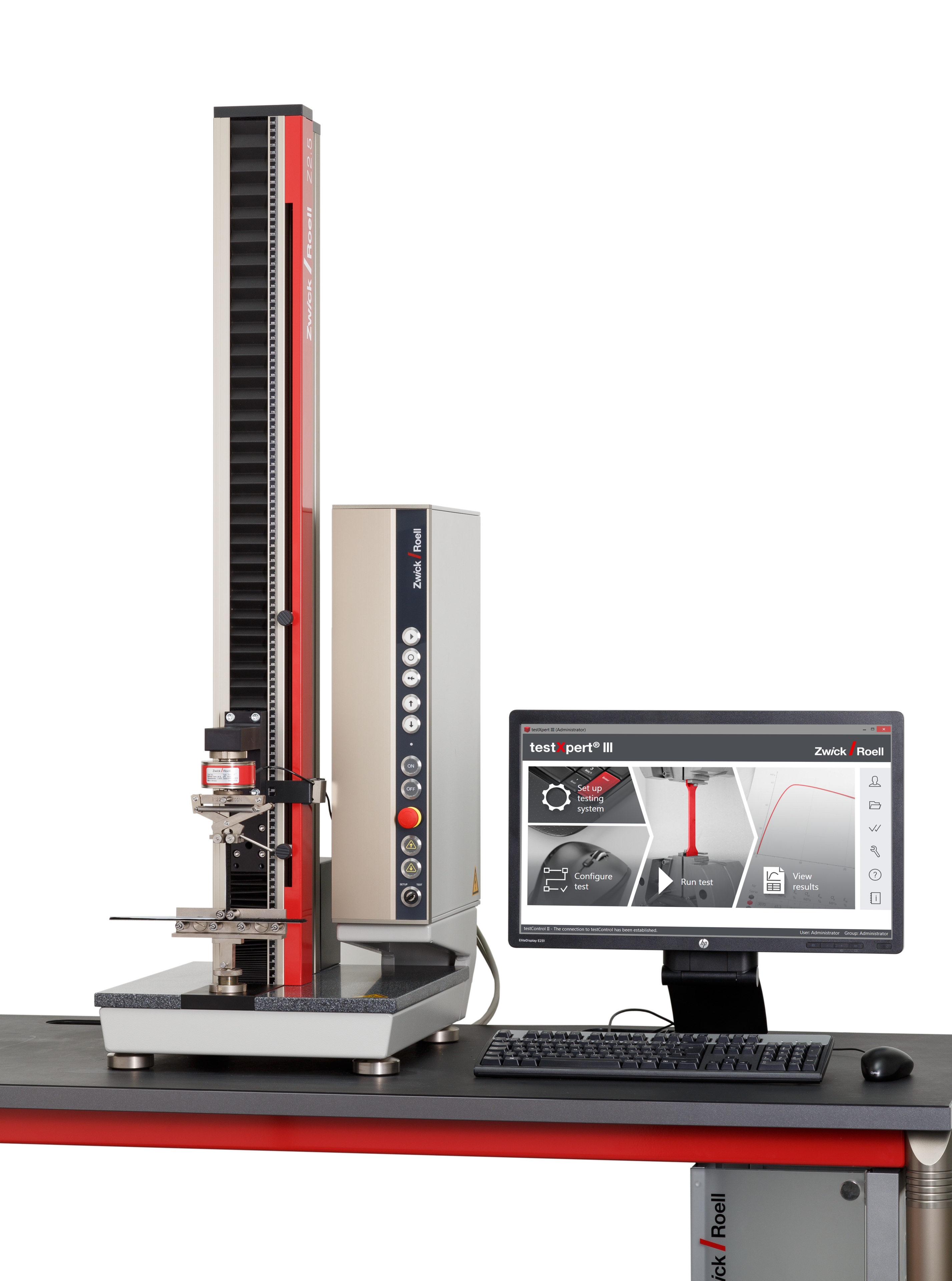
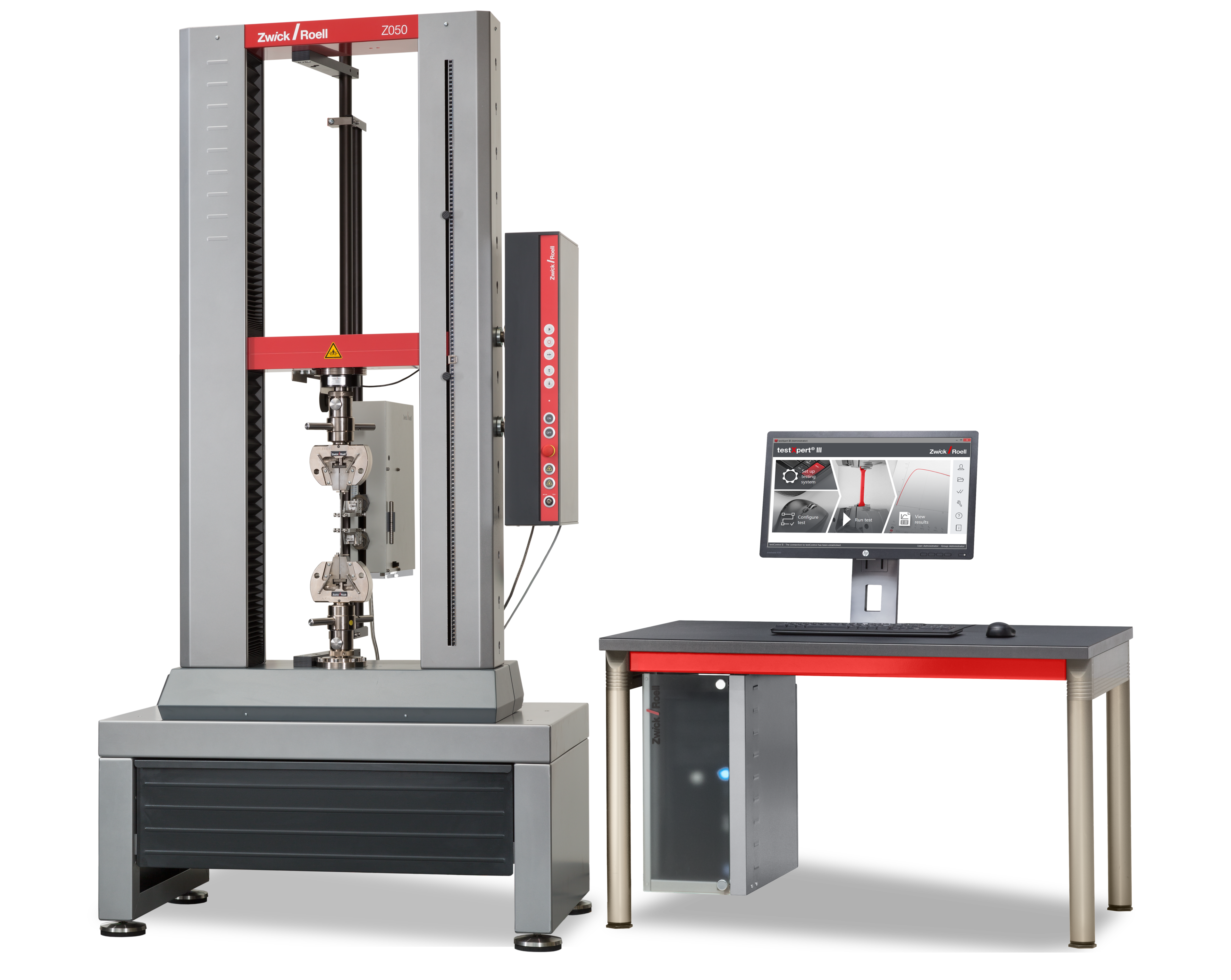
zwickiLine and ProLine series machines are ideal for determining the tear strength and strain at tear of condoms:
- The required force measurement range is covered by a load cell with a nominal force of 200 N.
- The crosshead speed is a constant 500±50 mm/min.
- A specimen grip for ring specimens is most suitable for this task.
A thickness measuring device can be connected via the serial port of the PC so that these measured values are automatically input into the test as well.
Our testXpert testing software enables user-friendly, standard-compliant testing.
Suitable extensometers
When testing condoms, the measurement accuracy of the extensometer is crucial. The requirements of the standard can be met either by extensometers that are mechanically attached directly to the specimen or by optical, non-contact extensometers. ZwickRoell offers suitable extensometers with high measurement accuracy – from cost-efficient, manual extensometers to fully automatic systems, completely without operator influence and with maximum reproducibility of test results.


