
Testing of injection needles to ISO 9626
- The break resistance of injection needles is determined according to standard ISO 9626 (Annex C) using a 2-point flexure test. The needle is held on one side and the free side is bent at a defined angle.
- To test the stiffness of the needle tubing to standard DIN EN ISO 9626 (Annex B), a 3-point flexure test kit is used. A defined flexure separation that corresponds to the needle gauge must be selected.

Traceable, tamper-proof test results in accordance with FDA 21 CFR Part 11
Traceable tamper-proof test results
- Ever-increasing demands are placed on software used in the medical and pharmaceutical industries to document the traceability of completed actions.
- With the traceability option, testXpert III enables logging of all actions and changes before, during and after the test, making test results and the documentation traceable and protecting them from manipulation.
- Integrated user management and functions such as electronic records and electronic signature ensure that test results are always protected from tampering.
- Together with the organizational measures and procedure instructions that apply to the individual companies themselves, the requirements of FDA in 21 CFR Part 11 are fulfilled.
- ZwickRoell also offers a qualification service package (DQ/IQ/OQ) for validation support.
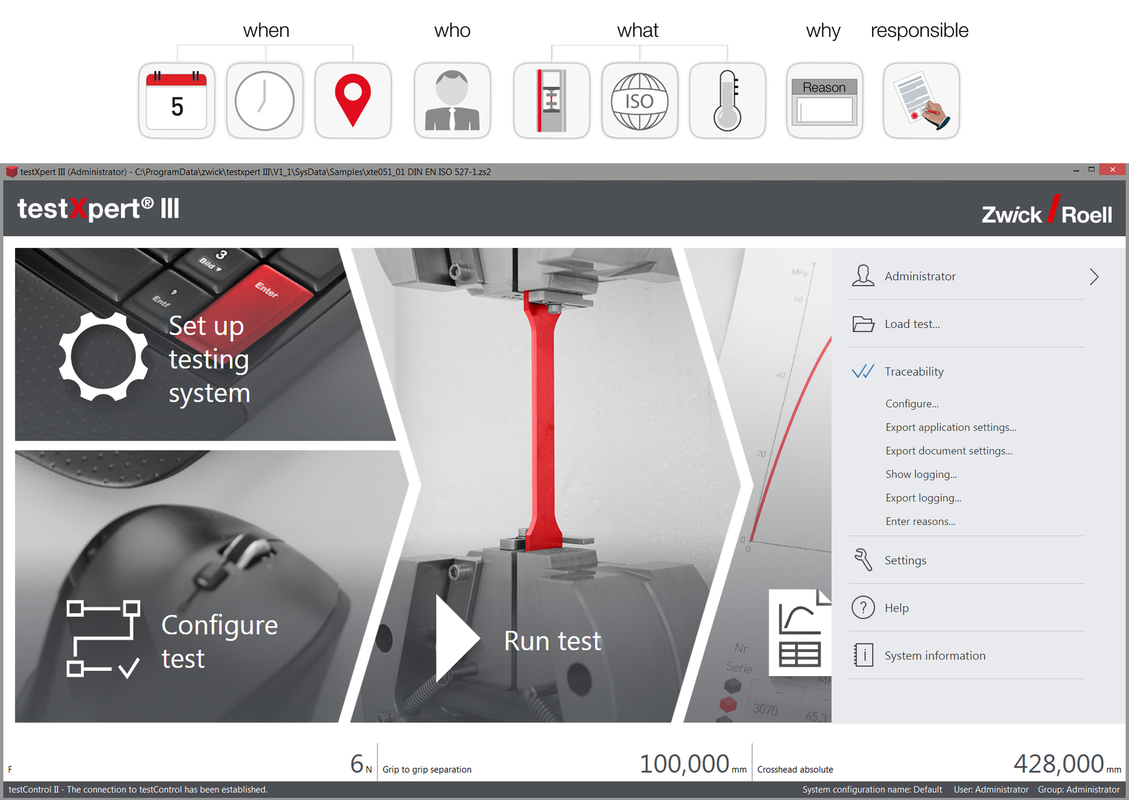
- testXpert III logs all test and system related actions and settings and can therefore always answer the question “When does who do what, why and who is responsible?”
Learn more about the testXpert III
Traceability option.