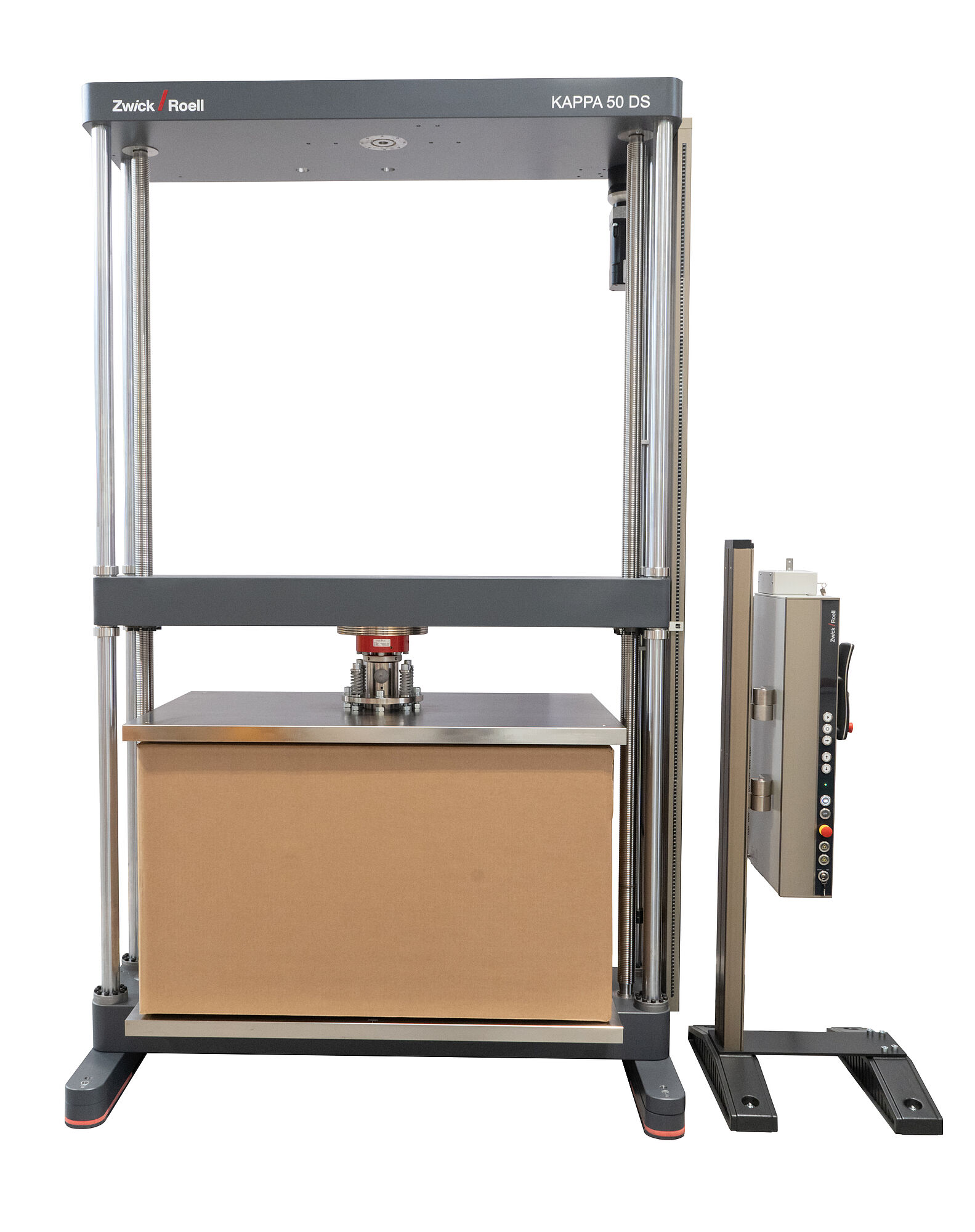

- 50 - 250 kN
- -80 to +2000°C
- Creep
- Stress relax
- SSRT, HE
- CCG
- Tensile, compression, flexure
- ISO 204
- ASTM E139
- EN 2002-005
- ASTM E1457
- ASTM G129
- ASTM F519
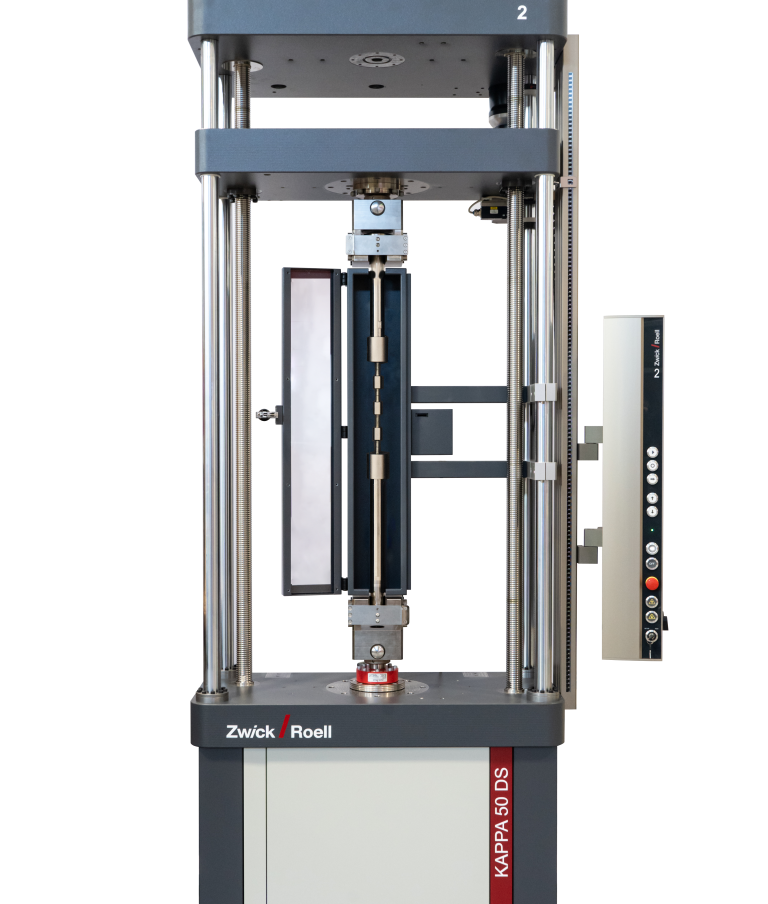
Kappa DS: the specialist for various environmental conditions
The flexible electromechanical creep testing machine Kappa DS is equipped with a double lead screw and was designed for classic and advanced creep tests. The large crosshead travel and the associated extended test area provide sufficient space for temperature, vacuum or inert gas chambers for example, making this testing machine ideal for tests under various environmental conditions.
The Kappa DS electromechanical creep testing machine offers a wide range of applications in ambient and high temperature conditions:
- Advanced creep tests
- Fatigue tests in the tensile range
- Strain modeling (e.g. determination of creep curve at different loads)
- Creep test with slow strain rates (SSRT)
- Creep data from components tests - Crack growth and widening tests
- Determination of hydrogen embrittlement
- Tests with stepless force and temperature adjustment
- Relaxation tests
- Creep tests up to break
- - Creep rupture
- Stress rupture - Classic creep tests
- Tensile, compression and flexure tests can also be performed with this testing machine
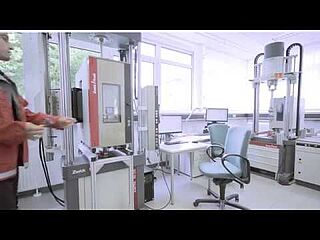
The Kappa DS in operation
Technical overview
| Test load Fmax | 50 | kN |
| Test area | ||
| Height | 1350 1 | mm |
| Width | 610 2 | mm |
| Load frame | ||
| Dimensions | ||
| Height | 2342 | mm |
| Width | 933 | mm |
| Width with machine electronics | 1157 | mm |
| Depth | 730 | mm |
| Weight | ||
| With machine electronics, approx. | 840 | kg |
| Drive | ||
| Crosshead speed vmin ... vmax | 1 ... 100 | µm/h ... mm/min |
| Deviation from the set drive speed, max. | ± 0.13 | % of vactual |
| Drive system travel resolution | 0.068 | nm |
| Crosshead return speed, max. | 100 | mm/min |
| Power input specifications | ||
| Supply voltage | 230 | VAC |
| Power consumption (full load), approx. | 2.3 | kVA |
- Maximum distance from the moving crosshead to the height-adjustable crosshead or base crosshead, without any accessories
- Clearance between the lead screws
- Measured over an interval of at least 5 s or 10 mm travel
| Test load Fmax | 100 | kN |
| Test area | ||
| Height | 1350 1 | mm |
| Width | 610 2 | mm |
| Load frame | ||
| Dimensions | ||
| Height | 2342 | mm |
| Width | 933 | mm |
| Width with machine electronics | 1157 | mm |
| Depth | 730 | mm |
| Weight | ||
| With machine electronics, approx. | 840 | kg |
| Drive | ||
| Crosshead speed vmin ... vmax | 1 ... 100 | µm/h ... mm/min |
| Deviation from the set drive speed, max. | ± 0.13 | % of vactual |
| Drive system travel resolution | 0.068 | nm |
| Crosshead return speed, max. | 100 | mm/min |
| Power input specifications | ||
| Supply voltage | 230 | VAC |
| Power consumption (full load), approx. | 2.3 | kVA |
- Maximum distance from the moving crosshead to the height-adjustable crosshead or base crosshead, without any accessories
- Clearance between the lead screws
- Measured over an interval of at least 5 s or 10 mm travel
| Test load Fmax | 150 | kN |
| Test area | ||
| Height | 1350 1 | mm |
| Width | 617 2 | mm |
| Load frame | ||
| Dimensions | ||
| Height | 2431 | mm |
| Width | 922 | mm |
| Width with machine electronics | 1158 | mm |
| Depth | 730 | mm |
| Weight | ||
| With machine electronics, approx. | 1120 | kg |
| Drive | ||
| Crosshead speed vmin ... vmax | 1 ... 100 | µm/h ... mm/min |
| Deviation from the set drive speed, max. | ± 0.13 | % of vactual |
| Drive system travel resolution | 0.068 | nm |
| Crosshead return speed, max. | 100 | mm/min |
| Power input specifications | ||
| Supply voltage | 230 | VAC |
| Power consumption (full load), approx. | 2.3 | kVA |
- Maximum distance from the moving crosshead to the height-adjustable crosshead or base crosshead, without any accessories
- Clearance between the lead screws
- Measured over an interval of at least 5 s or 10 mm travel
| Test load Fmax | 250 | kN |
| Test area | ||
| Height | 1350 1 | mm |
| Width | 617 2 | mm |
| Load frame | ||
| Dimensions | ||
| Height | 2431 | mm |
| Width | 922 | mm |
| Width with machine electronics | 1158 | mm |
| Depth | 730 | mm |
| Weight | ||
| With machine electronics, approx. | 1120 | kg |
| Drive | ||
| Crosshead speed vmin ... vmax | 1 ... 100 | µm/h ... mm/min |
| Deviation from the set drive speed, max. | ± 0.13 | % of vactual |
| Drive system travel resolution | 0.068 | nm |
| Crosshead return speed, max. | 100 | mm/min |
| Power input specifications | ||
| Supply voltage | 230 | VAC |
| Power consumption (full load), approx. | 2.3 | kVA |
- Maximum distance from the moving crosshead to the height-adjustable crosshead or base crosshead, without any accessories
- Clearance between the lead screws
- Measured over an interval of at least 5 s or 10 mm travel

Modular high-temperature accessories for creep testing machines
Accurate creep tests under defined temperature and environmental conditions is crucial for reliably determining the temperature-dependent elastic behavior, strength and yield point of high-temperature resistant materials. ZwickRoell equips creep testing machines with a wide range of modular high-temperature accessories, designed for testing in temperatures ranging from -80°C to 2,000°C.
The optimal combination of heating system, precise temperature control, suitable thermocouples, load strings and coordinated extensometers is the basis for reliable test results in creep testing.
Heating systems for test temperatures up to +2,000°C
A wide range of heating systems is available for creep testing systems to meet various standards and customer requirements. Get an overview of the possible alternatives:
| Temperature | Environment | Advantages | |
|---|---|---|---|
| Temperature chamber |
|
|
|
| High-temperature furnace with 1, 2 or 3 heating zones |
|
|
|
| Induction heating system |
|
|
|
| Vacuum chamber |
|
|
|
Optical extensometer
The differentiating advantage of extensometers featuring non-contact measurement is that they can be used right up to break without risk of damage, even with specimens that are critical in this respect. Especially in an elevated temperature range, non-contact extensometers provide a defining advantage over contact extensometers, since the access to different heating systems can be sealed with view windows.
Applications for the video extensometer for high temperatures:
- Long-term applications, tensile, compression and flexure tests, cyclic applications (< 2 Hz)
- A variety of materials such as metals, refractory materials, ceramics
- Temperature range: ambient temperature up to +1,400 °C

Contact extensometers
Contact extensometers for creep testing are available for tensile as well as compression and flexure tests. In addition to different accuracy classes and measurement ranges, extensometers for extended temperature ranges are also available. A distinction is made between side- and axial-attaching extensometers, which are suitable for special test types such as crack propagation testing. Depending on the specimen shape, different sensor arms are used.
Our engineers are happy to help you select the optimal system for your creep testing machine from our extensive portfolio of extensometers.


Other customers using ZwickRoell creep testing systems
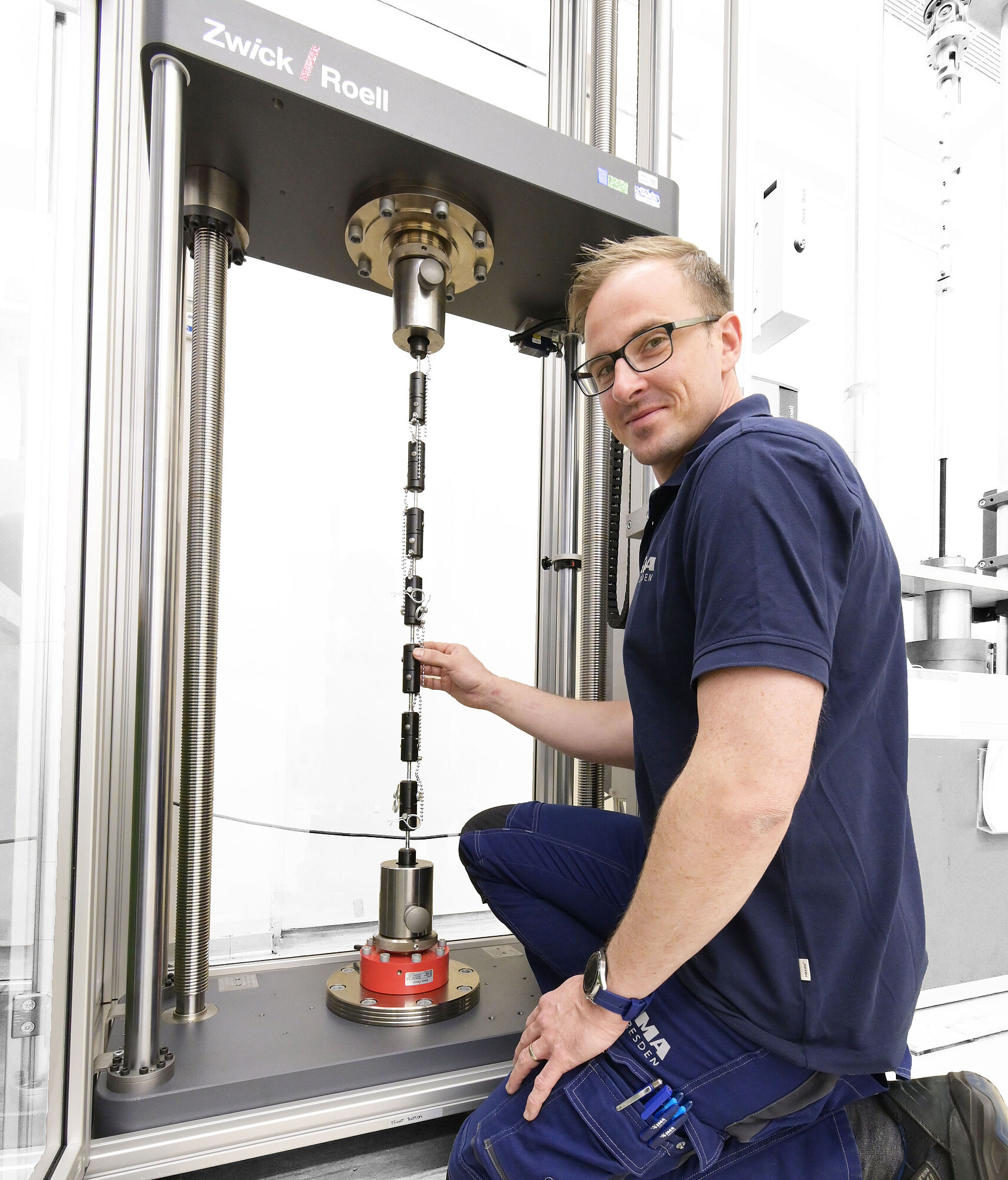
IMA Dresden, Germany
OGMA, Portugal