
Injection Systems Put to the Test: Smart Testing, Global Success
From prefilled syringes to complex combination products such as autoinjectors, pens or on-body delivery systems (OBDS): Injection systems are very versatile, and so are the test tasks associated with them, which range from individual tests on components such as needles or stoppers to tests on prefilled syringes and comprehensive function tests on complex devices.
This becomes particularly challenging for companies with multiple locations. Transferring methods is challenging in any case. Across all locations, in addition to consistent processes, it is especially important to ensure comparable test results that reflect product quality alone.
The solution: Smart testing is based on three key success factors, which we will introduce below.
Reliable test results High specimen throughput International reproducibility

Three key criteria play a decisive role
- Reliable test results and data integrity for reliable decisions
- High specimen throughput and short cycle times
- Maximum reproducibility through method transfer across locations for quality assurance
These criteria are demanding, but they can be met – provided you know what is important.


Reliable test results – the foundation for making confident decisions
Reliable and accurate data are an essential basis for decisions you can count one. For example, during batch release, errors can have both supply-related and serious financial consequences. To achieve this, test results must not only be precise and correct, but also reproducible and traceable – regardless of location.
Data integrity is essential: It ensures that all data remains complete, consistent and tamper-proof throughout its entire life cycle. In the regulated environment of the medical and pharmaceutical industries, this is not optional; it is a mandatory requirement: FDA 21 CFR Part 11 requires tamper-proof, traceable results.
How can you obtain reliable test results?
| What you need for reliable test results | Why? | Solution & more information |
|---|---|---|
| Repeatable test conditions | Test results are only reliable if they are obtained under the same conditions, regardless of the day. This means identical forces, positions, displacements, temperatures, etc. | Establishing repeatable test conditions |
| Identify discrepancies at an early stage | If a sensor is adjusted or its function is impaired, this will distort the test result | Daily Checks at regular intervals ensure that all sensors are functioning properly |
| Reproducible test results | Regardless of where the testing is done – whether in a different laboratory or in a different country – the results can only be reproducible if the conditions are also the same | Define or transfer standardized test sequences across all locations |
| Minimal operator influence | Operators are human – and they sometimes make mistakes. This leads to scatter of test results or, in the worst case, to errors, for example due to incorrect input or handling | Automatic sequences and smart aids reduce operator influence |
| Traceable results | This way, you know precisely who tested what, when, how, where and why – exactly as required by FDA 21 CFR Part 11 | FDA 21 CFR Part 11: Traceable and tamper-proof test results with testXpert |
High specimen throughput – even without a robot
A high specimen throughput reduces throughput times and lowers costs for testing effort. To achieve this, a robotic solution isn't always necessary – there are high-performance alternatives between manual testing and fully automated testing.
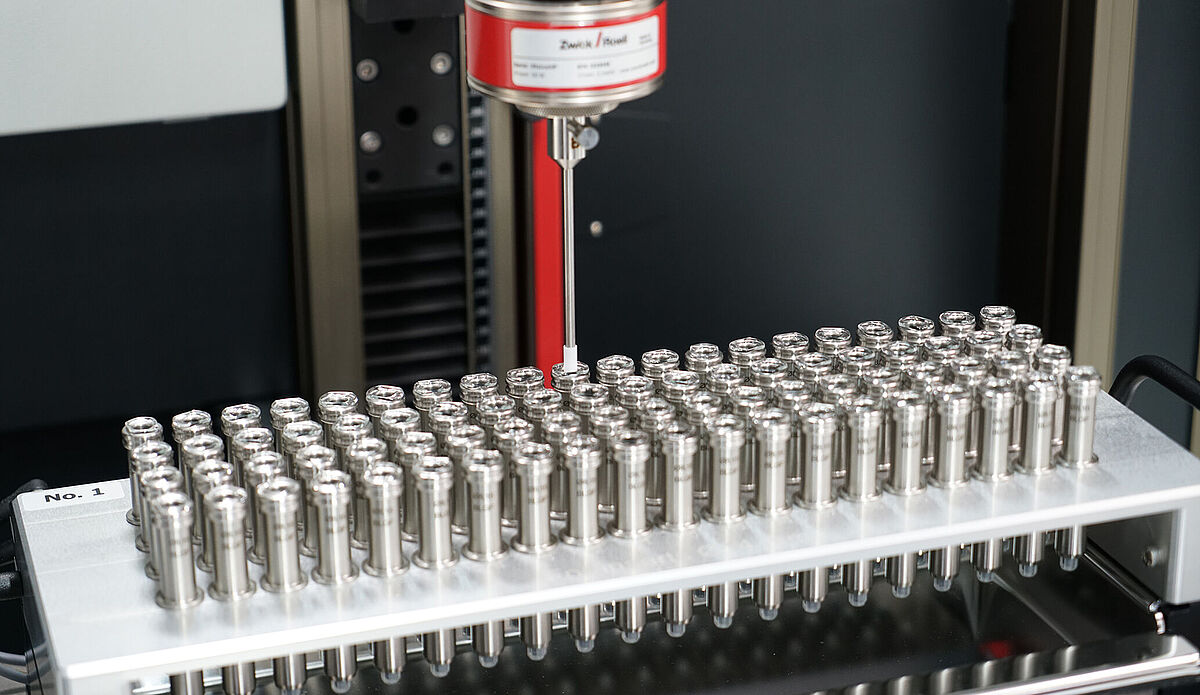
For example, X-Y table or rotary magazine solutions: Larger quantities of specimens, such as syringes, cartridges, or vials can be tested using quick change magazines in series and without operator influence. To meet the system's requirements in terms of test throughput and modularity, various options are available, such as a precision X-Y table for 80 specimen or a rotary magazine for 15 syringes. With both solutions, operator influence is virtually eliminated. All systems are controlled via the testXpert testing software with a specimen-specific test program: always in accordance with FDA 21 CFR Part 11.
Another advantage: Each test is performed in the exact same manner. This improves both the accuracy and the reproducibility of the test results and, ultimately, helps make testing more cost-effective.
This way, high specimen throughput is combined with high-quality test results.


International reproducibility – successful across the world
For companies with multiple locations, the reproducibility and traceability of test results are critical to their very existence. When comparing test results across locations, it must be clear that those results are not affected by differences in the test sequence. Test methods and results must be directly transferable to other locations around the world. The same applies to suppliers.
Therefore, it is even more important here to achieve high-quality results. It is essential to completely eliminate operator influence. Differences in qualifications or operation methods due to country-specific variations in the training and experience of the workforce must not play a role. The test sequence must be consistent across the world, and operation must be so simple that no deviations occur.
Standardized machine settings and identical sequences at all locations ensure quality. A joint FAT (Factory Acceptance Test) for all machines can verify that the machine settings and test procedures are identical across the board.
Modern connectivity makes international comparisons even easier: Central data management systems (LIMS, QMS, DAM) record and analyze all test results across all locations. This enables the comparison of quality indicators, the identification of trends, and the early detection of deviations. Visualized dashboards with filter functions by product, batch, location, or time period provide transparency.
The testXpert testing software ensures fast data transfer to LIMS, QA, CAQ, or ERP systems with its standardized import and export interfaces. Alternatively, you can use testXpert's Analytics tools for centralized evaluation or to generate long-term statistics, thereby providing transparency on trends, deviations, and process stability.
Conclusion
From the performance specifications to the final qualification, it is a complex process. That's why, when purchasing a testing system, you should assess what support the vendor provides – because it's not just about the materials testing machine, but about seamlessly integrating the testing sequences into the overall process.
Therefore, we've established our own qualification department and support our customers from the URS through to qualification. You benefit from proven concepts, save time and money, and don't have to reinvent the wheel. And, of course, all of our solutions meet the requirements of FDA 21 CFR Part 11.

