Testing of the Drive Train
Wherever power is converted and transferred, tests ensure the reliability of the installed component. ZwickRoell has over 50 years of experience testing engine and drive components. Initially, the load tests performed were simple, but today extremely specific properties must be measured and documented, and also at high speeds, torques, and extreme temperatures.
Gear testing Drive shafts Rubber-metal elements Request a consultation Downloads

Hardness testing of gears
Gears are key elements in vehicle drive trains. High wear resistance is essential for meeting the automotive industry's requirements in terms of lifespan. Heat treatment of the gears produces a wear-resistant surface that also has high ductility at its core. Hardness testing is used for quality control to verify these material properties.
- Tests are performed on the tooth flank, at the tooth root, and in the base material, depending on the function and load zone. The Vickers method in accordance with ISO 6507 or ASTM E384 is used to determine the thickness of the hardened surface layer according to ISO 18203 with a hardness curve.
- For the determination of surface hardness, the Rockwell method according to ISO 6508 or ASTM E18 can also be used.
Modern Vickers hardness testers such as the DuraScan from ZwickRoell cover various load ranges with a single instrument and support standard-compliant tests according to Knoop, Brinell, and in some cases even Rockwell.


Dynamic gear testing
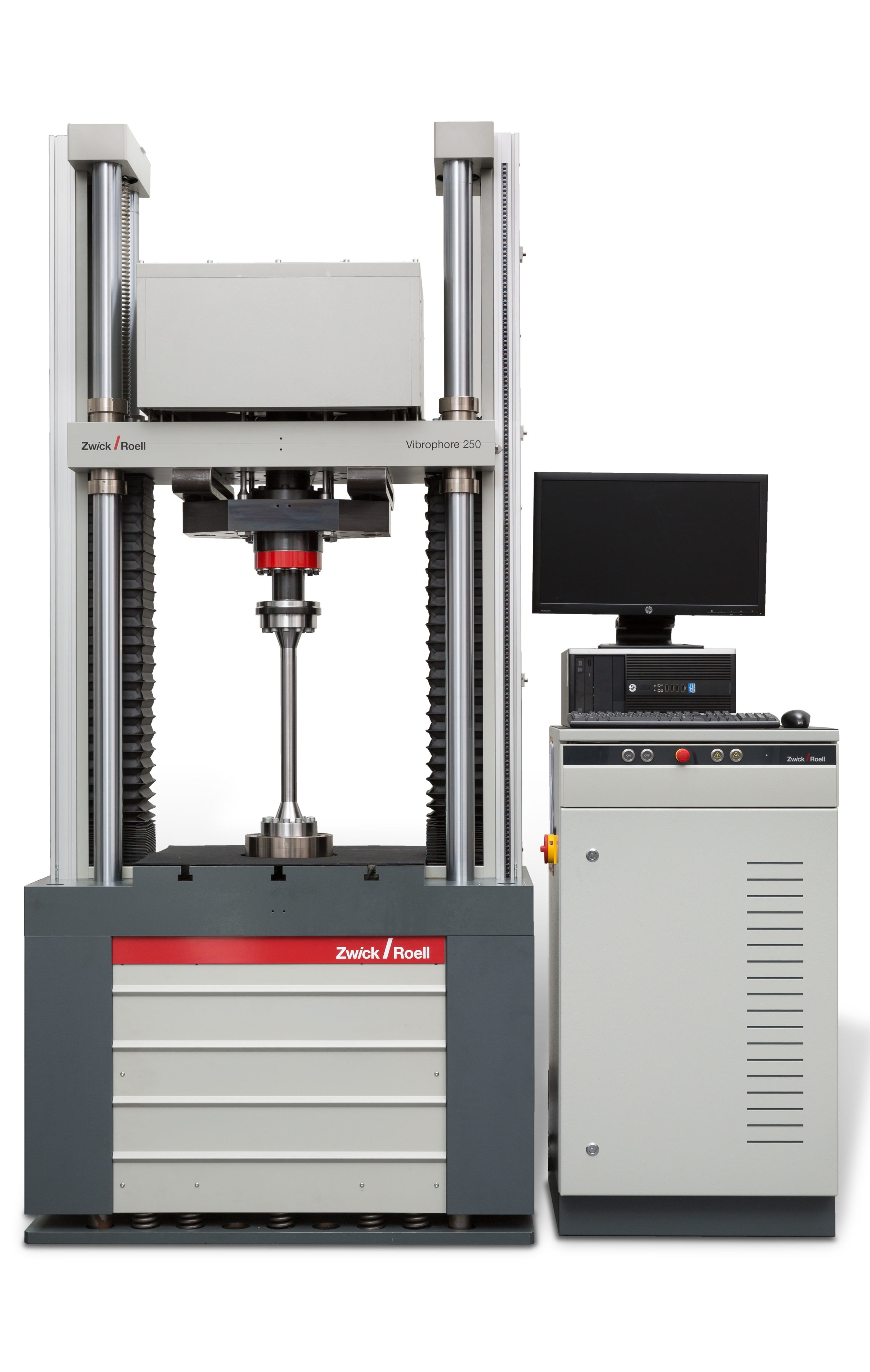
The dynamic tooth root strength of gears is determined using a special fixture for the Vibrophore resonance testing machine. The gear is clamped in the device with a gap of two teeth between the teeth, and a cyclic compression test is performed until one of the teeth breaks. Following the fatigue test, an S-N curve can be determined.
Fixtures are available for both straight and helical teeth. A particular advantage of gear testing is that several fatigue tests can be performed on one gear. After a tooth breakage, the gear can be rotated and re-clamped.


Torsion test on drive shaft
Drive shafts are tested in a torsion test. The drive shaft is clamped in a TorsionLine torsion testing machine and twisted until it breaks.
This test is particularly important in quality control and checks whether the required torque is transmitted in the connection from the gearbox to the wheel.

Torsion testing of rubber-metal elements
Rubber-metal elements are used as vibration-damping elements in both the automotive sector and in industry.
A TorsionLine torsion testing machine is used to determine the stiffness of the rubber-metal element in the torsional direction. The element is clamped into the TorsionLine specimen grips and twisted. The force-torque characteristic curve of the damper is then determined.

High-temperature testing of rubber-metal components
Rubber-metal components in vehicles are often located in close proximity to the engine, transmission, or exhaust components and are therefore exposed to elevated ambient temperatures. In addition, the cyclic mechanical stress on these elastomers leads to self-heating, which further increases the component temperature.
Elevated temperatures significantly affect the mechanical behavior of rubber and accelerate thermal aging processes such as changes in stiffness, permanent deformation, and loss of damping. Our high-temperature testing systems and creep testing machines examine the functional reliability and lifespan of these rubber-metal elements under realistic operating conditions.