Automated Testing of Medical Applications
Depending on the requirements, ZwickRoell testing systems for medical applications can be equipped with manual, semi-automatic or fully automatic specimen feeding, or enable serial or parallel tests.
AUTOINJECTORS LUER LOCK CONNECTIONS PEN INJECTOR / INSULIN PEN Residual Seal Force (RSF) Glide force test on multiple syringe systems Serial testing of syringes Automated testing of syringes


Automated autoinjector testing according to ISO 11608-5
For increasing testing volumes and large production batches, ZwickRoell offers scalable automation solutions – from automated laboratory support to fully automated 24/7 testing.
Common features of all automated ZwickRoell solutions
- ISO 11608-5 compliant testing of all relevant functional parameters
- Automated specimen feeding and removal
- Video capturing of the injection process for additional documentation
- Automated specimen disposal including good/bad sorting
- Daily verification of all quality-relevant measuring equipment (Daily Checks)
- Use of ZwickRoell or customer-specific trays
ISO 80369 – Automated testing of Luer lock connectors
When dealing with large production batches, a testing process that saves time and resources is often important. ZwickRoell provides a simple solution for automated testing of Luer lock connectors.
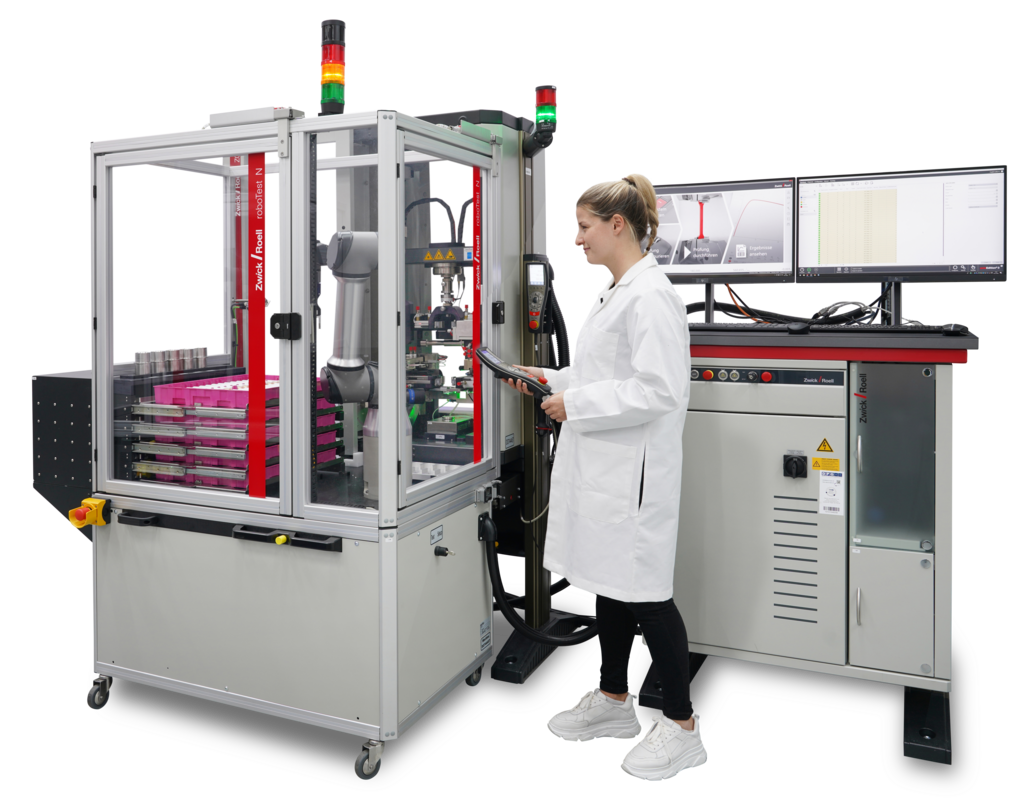
The testing assistant roboTest N supports the user in performing the test to ISO 80369. Typically, 30 Luer Lock connectors can be tested automatically with one magazine filling. The testing assistant transports the specimen from the magazine to the Luer Lock testing system and positions it in the specimen grips. Here, the thread as well as the seal tightness of the Luer Lock connector are tested. The testing assistant roboTest N then removes the specimen from the machine and returns it to the magazine.
The system can be easily and flexibly adapted to changing test requirements without requiring any special programming knowledge. For all robotic testing systems, the autoEdition3 automation software is used for information input and control.

Fully automated testing of autoinjectors and pens
The automated testing system roboTest N can be used for pens and autoinjectors. They take care of specimen handling and perform all tests required by the standard. The system enables all relevant function tests to be performed on a single specimen within a single test cycle. This significantly reduces testing effort and the number of test specimens required while ensuring a complete functional analysis of the autoinjector or pen.
Additional options such as click or color recognition and a magazine extension up to 150 specimens can also be used. For pen testing, optical dosing field recognition and a priming station for removing air bubbles from the pen can also be added.
Precise sensor technology and a sequential testing process minimize operator influences such as misaligned insertion or measurement errors. The result is reproducible and reliable test results.
| Device | Pen | Autoinjector |
|---|---|---|
| Standard | ISO 11608-1 ISO 11608-2 ISO 11608-3 | ISO 11608-5 |
| Specimen handling system | roboTest N | roboTest N |
| Capacity | 30 - 150 pens | 30 - 150 autoinjectors |
| Additional options |
|
|
Parallel glide force tests on multiple syringe systems
One application is for example, syringes used in syringe drivers. In this case the syringe plungers are depressed over a lengthy period. To reduce the test time the testing machine can be upgraded to 6-8 test axes with the corresponding number of load cells. This enables individual force recording for each syringe.
This fixture comprises an AllroundLine table top testing machine expanded to 6–8 test axes to hold the corresponding number of load cells. It is suitable for use both in a laboratory and for in-process monitoring, and is used to test various frictional forces between the syringe plunger and barrel or the sealing rings in the syringe barrels. The syringe holding fixture can accommodate syringes of various sizes, as well as two medium containers for catching the expelled liquid. This fixture can be used to test frictional forces on cartridges. The force sequences can be synchronized thanks to the individual height adjustment feature.

Serial testing of syringes
If it is necessary to test a large number of syringes in a short time a materials testing machine with a carousel can be used. A large number of specimens can be fed to the machine via a magazine and automatically tested one after the other. Operator influence on the test is reduced, resulting in greater stability in MSA/Gauge R&R studies.
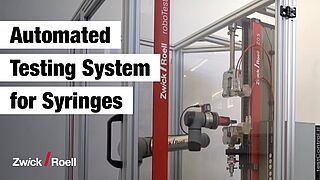
Automated testing of syringes
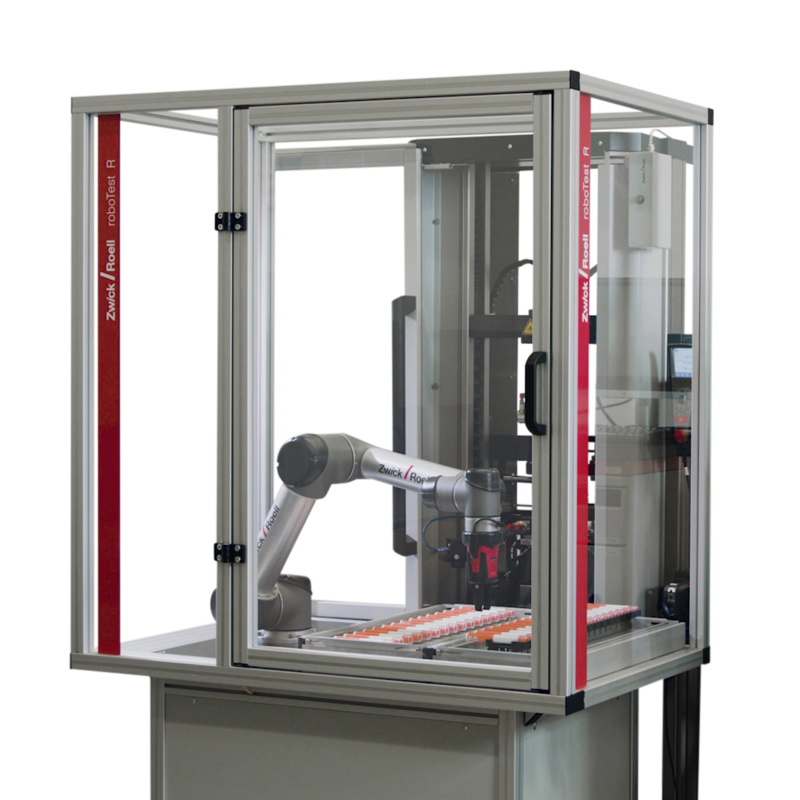
The production in large batches often requires a time- and resource-saving test process. With the testing assistant roboTest N, ZwickRoell offers an easy solution for automated testing of syringes.
The testing assistant roboTest N supports the user in performing tests to ISO 11040, for example. The system can be used to automatically test a smaller batch of syringes.
Various test methods, including testing of the plunger glide force and testing of the cap-removal force can be performed with the same machine. To identify the test method currently in use, the testing assistant roboTest N uses a scanner to verify the installed equipment and the specimens in the magazine for consistency before testing the first specimen.
The testing assistant then transports a specimen from the magazine to the testing machine and positions it in the corresponding specimen grips. To test the plunger glide force, the syringe plunger is pressed in via a compression test. To determine the syringe cap-removal force, the cap is removed via a tensile test. The testing assistant roboTest N then removes the specimen from the machine and returns it to the magazine.
With the appropriate test arrangement, it is also possible to carry out additional tests described in the ISO 11040 standard.
The system can be easily and flexibly adapted to changing test requirements without requiring any special programming knowledge. Input and control is realized through the autoEdition3 automation software that is implemented in all automated testing systems.


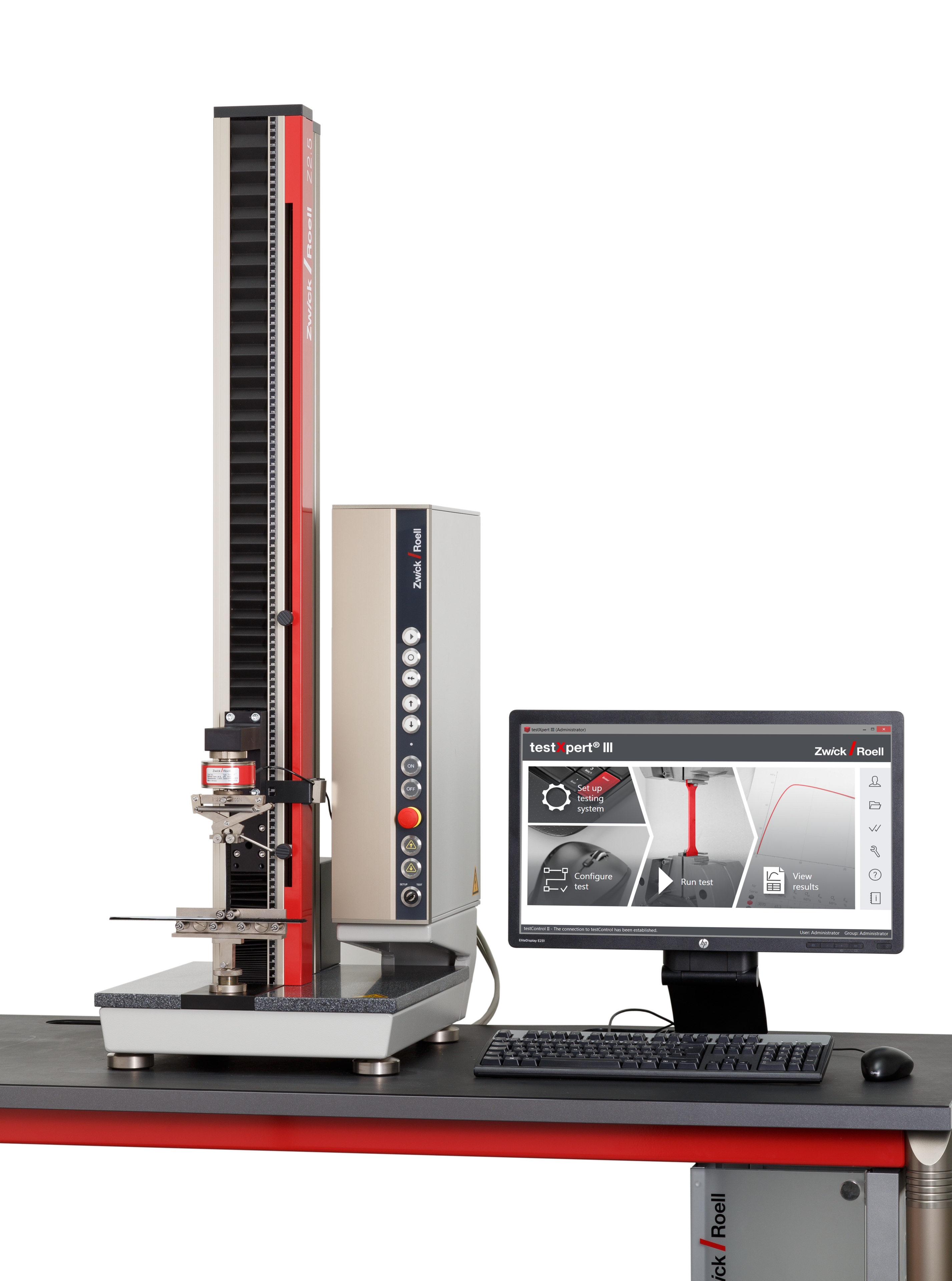
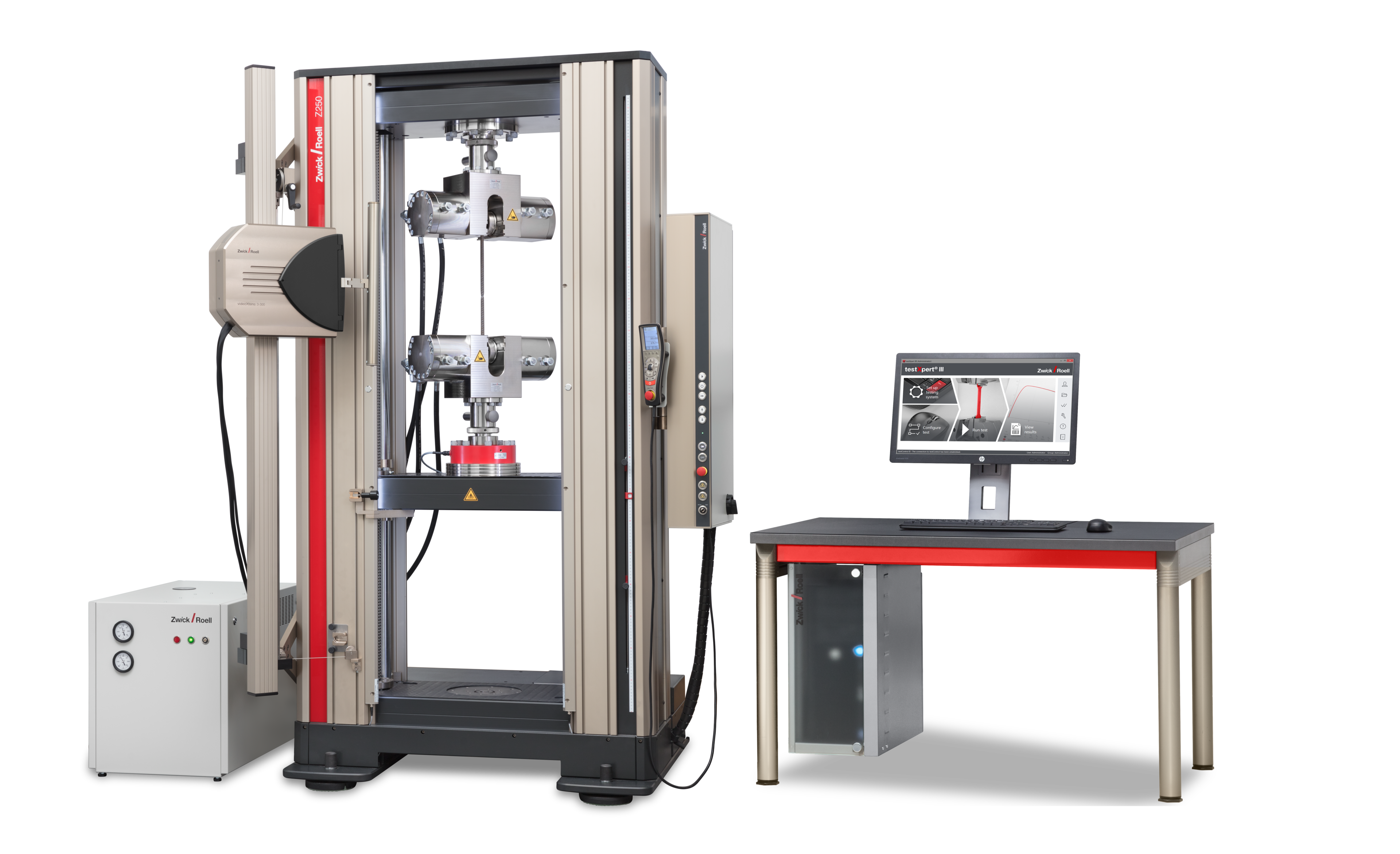


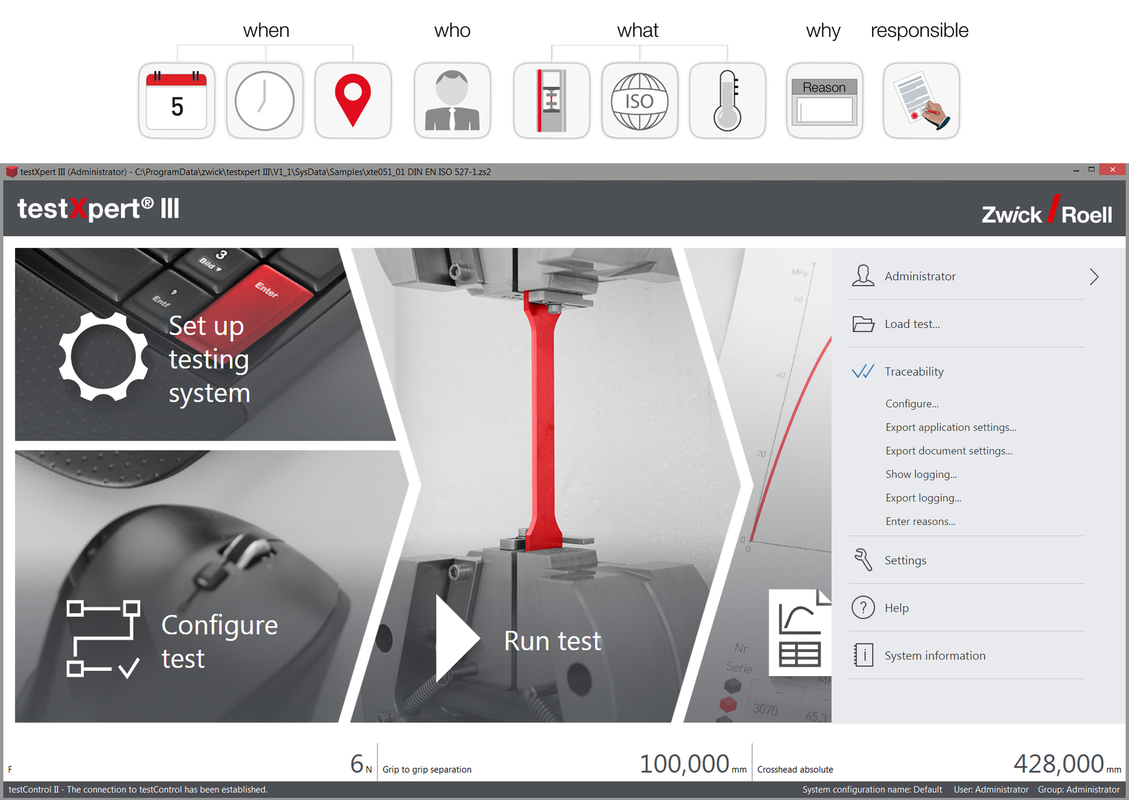
Traceable, tamper-proof test results in accordance with FDA 21 CFR Part 11
- Ever-increasing demands are placed on software used in the medical and pharmaceutical industries to document the traceability of completed actions.
- With the traceability option, testXpert III enables logging of all actions and changes before, during and after the test, making test results and the documentation traceable and protecting them from manipulation.
- Integrated user management and functions such as electronic records and electronic signature ensure that test results are always protected from tampering.
- Together with the organizational measures and procedure instructions that apply to the individual companies themselves, the requirements of FDA in 21 CFR Part 11 are fulfilled.
- ZwickRoell also offers a qualification service package (DQ/IQ/OQ) for validation support.
- testXpert III logs all test and system related actions and settings and can therefore always answer the question “When does who do what, why and who is responsible?”
Learn more about the testXpert III
Traceability option.