
ISO 11608-6 OBDS Testing – "One Test - All Results"
ISO 11608-6 defines test requirements for on-body delivery systems (OBDS), i.e., body-worn injection systems for highly viscous and/or large-volume drugs. In practice, deviations arise primarily due to complex test procedures, varying test specimens, and factors that interfere with volume measurement. Reproducible conditions across all measurement parameters are crucial. ZwickRoell supports this with a “One Test – All Results” solution featuring sequential test procedures, precise sensors, and software-based standardization.
Sources of Error & Challenges Checklist Test Procedure Test Solution Ypsomed Reference Request a Consultation FAQ Downloads


ISO 11608-6 OBDS testing: Key facts at a glance
Due to their specific application, OBDS have different testing requirements than handheld autoinjectors. Therefore, the separate standard ISO 11608-6 was introduced.
- ISO 11608-6 defines specific test requirements for OBDS, such as dose accuracy, injection time, injection profile, and injection depth, with detailed information on determining and reporting dose accuracy in Annex B
- For testing the automatic functions of the OBDS, it refers to ISO 11608-5.
- If protection functions against injuries caused by sharp or pointed objects are claimed, the requirements specified in ISO 23908 (Protection against injuries caused by sharp or pointed objects) apply.
- An overview of the different test methods and standards for determining adhesive forces can be found in Annex A.
- ISO 11608-6 deliberately allows flexibility in the design of OBDS in order not to limit their diversity; however, the various design features and functionalities are, of course, taken into account in the risk assessment.
Together with the instructions for use (IFU), ISO 11608-6 forms the basis for the risk assessment, which defines the specific testing requirements.
Common sources of error and challenges in OBDS testing according to ISO 11608-6
- Testing specimens with different geometries makes it difficult to ensure the comparability of the results.
- The wide variety of OBDS designs requires customized test procedures.
- Static charge, evaporation, or crystallization can affect the determination of volume.
- Minor deviations in injection depth often go undetected without precise measurement technology.
- Manual interventions and operator influences increase the variability in results.
- Acoustic and visual signals are often not recorded completely or in a reproducible manner.
Checklist: What really matters in OBDS testing
Efficient planning and qualification from a single source
The planning and qualification of an OBDS testing system involve a great deal of effort. ZwickRoell supports you throughout the entire process and takes the strain off your internal resources.
- URS:A structured template guides you step by step through the process of creating your user requirements specification.
- DQ, IQ, and OQ:Our experienced in-house qualification team handles the qualification process with customized packages for design, installation, and operational qualification.
- FAT and SAT: Upon request, we can perform the acceptance testing at ZwickRoell as well as the acceptance testing of the testing system at your location.
- Traceability: Our white paper answers key questions about implementing the requirements of FDA 21 CFR Part 11 and the EU GMP Guidelines, Annex 11

Precise dose accuracy down to the last drop
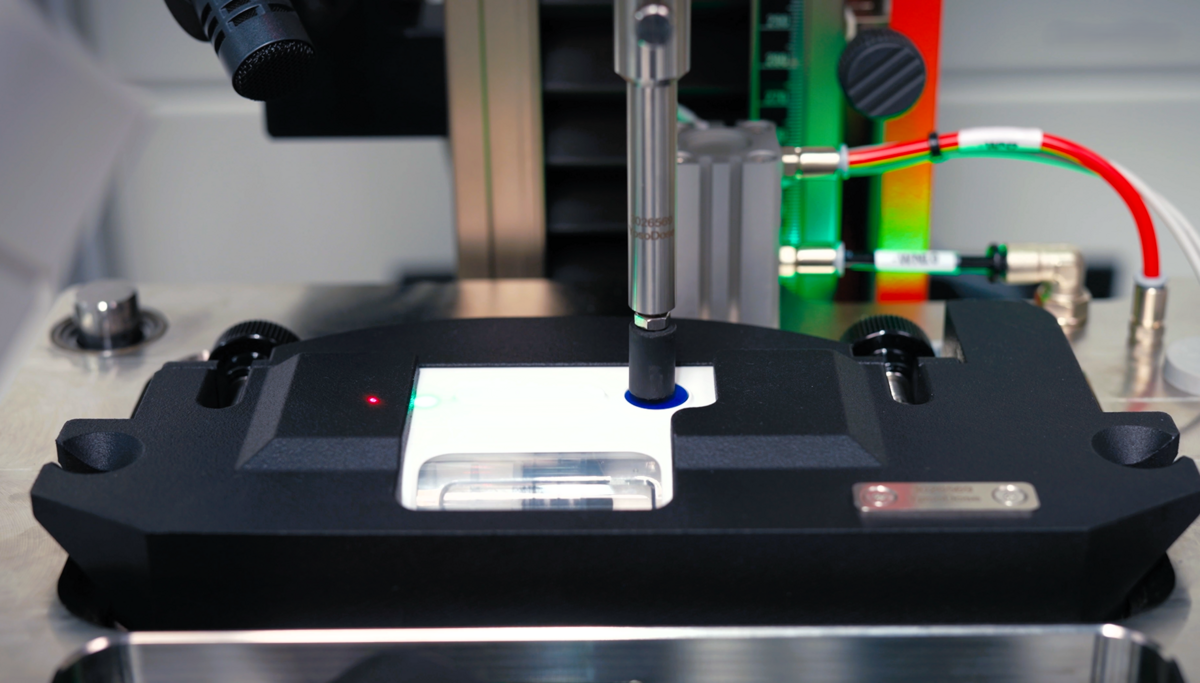
When assessing the dose accuracy of an on-body delivery system, not only the delivered dose but also its complete and precise capture down to the last drop is critical. The ZwickRoell testing solution uses a needle-immersion method to ensure that even the smallest residual amounts are reliably detected, thereby supporting a standards-compliant determination of dose accuracy in accordance with ISO 11608-6.
If the dose is administered in multiple segments, each individual bolus is recorded separately and reported in the results documentation. At the same time, the testing solution minimizes factors that could skew the measurement results.
- Complete measurement of the dispensed liquid down to the last drop
- Reduction of electrostatic influences on the weighing result
- Prevention of crystallization upon contact with air
- Minimizing the effects of evaporation
- Separate evaluation of individual dose segments

Precise measurement of injection depth and injection profile
Simply measuring volume is not sufficient for a reliable functional evaluation of an on-body delivery system. The injection depth, injection time, and injection profile must also be recorded in a reproducible manner. This is particularly evident in the case of injection depth: Here, fractions of a millimeter determine whether the active ingredient is delivered into the intended tissue layer.
The ZwickRoell testing solution records these values throughout the entire dose delivery process and displays them clearly in testXpert III.This simplifies the evaluation of functional deviations or interruptions during the injection process.
- Injection depth measured using high-resolution, camera-based measurement
- Total injection time for dose delivery
- Individual dose segments in multi-stage delivery
- Pauses or stops during the injection
- Injection profile showing dose over time
- Live graphical analysis of all relevant test values in testXpert III

Reproducible results thanks to “One Test – All Results”
A common cause of result scatter is the use of different specimens, test stations, or reclamping operations. Each new repositioning introduces additional tolerances and reduces the comparability of results.
The ZwickRoell testing solution therefore follows the "One Test – All Results" approach. Relevant test values are recorded during a sequential test run on the same specimen. This reduces repositioning errors and improves the traceability of the results.
The following information is recorded during a test run:
- Actuation force of the start button
- Acoustic and visual signals before, during, and after the injection
- Injection depth measured using a camera-based system (accuracy < 0.05 mm)
- Injection time, injection volume, and injection profile
- Dose accuracy without interference from static electricity, crystallization, or evaporation
- Time-synchronized video recording of the entire injection process

Traceable evaluation of acoustic and visual Signals
Many on-body delivery systems communicate with the user through clicks, beeps, LEDs, or flashing patterns. The ZwickRoell testing solution combines a microphone, a video system, and automated analysis to capture these signals reproducibly and document them objectively. This makes it possible to evaluate the start, progress, and end of an injection in a traceable manner.
The analysis focuses on:
- Acoustic signals such as clicks and beeps
- Visual signals and flashing patterns before, during, and after the injection
- Automatic decoding of relevant user signals
- Time-synchronized video recording of the entire test procedure

Standardized test procedures with minimal operator intervention
Manual data entry, variations in the positioning of the specimen, and custom operating procedures are among the most common causes of non-reproducible results. The testXpert III testing software therefore supports standardized test procedures through injector-specific test programs and automated process steps. Appropriate, interchangeable clamping devices enable the defined positioning of different OBDS types without the need for realignment.
When switching to a different OBDS, the appropriate default settings are loaded automatically. Test results are automatically documented, can be integrated into existing IT systems, and support the requirements of regulated environments, including FDA 21 CFR Part 11-compliant documentation.
Functions at a glance:
- Automatic presets
- Clamping device for easy specimen repositioning
- Clear presentation of results
- Automated test reports
- IT integratoin via interfaces
- Documentation compliant with FDA 21 CFR Part 11
- User and permission management
Adhesion force testing in the second test area
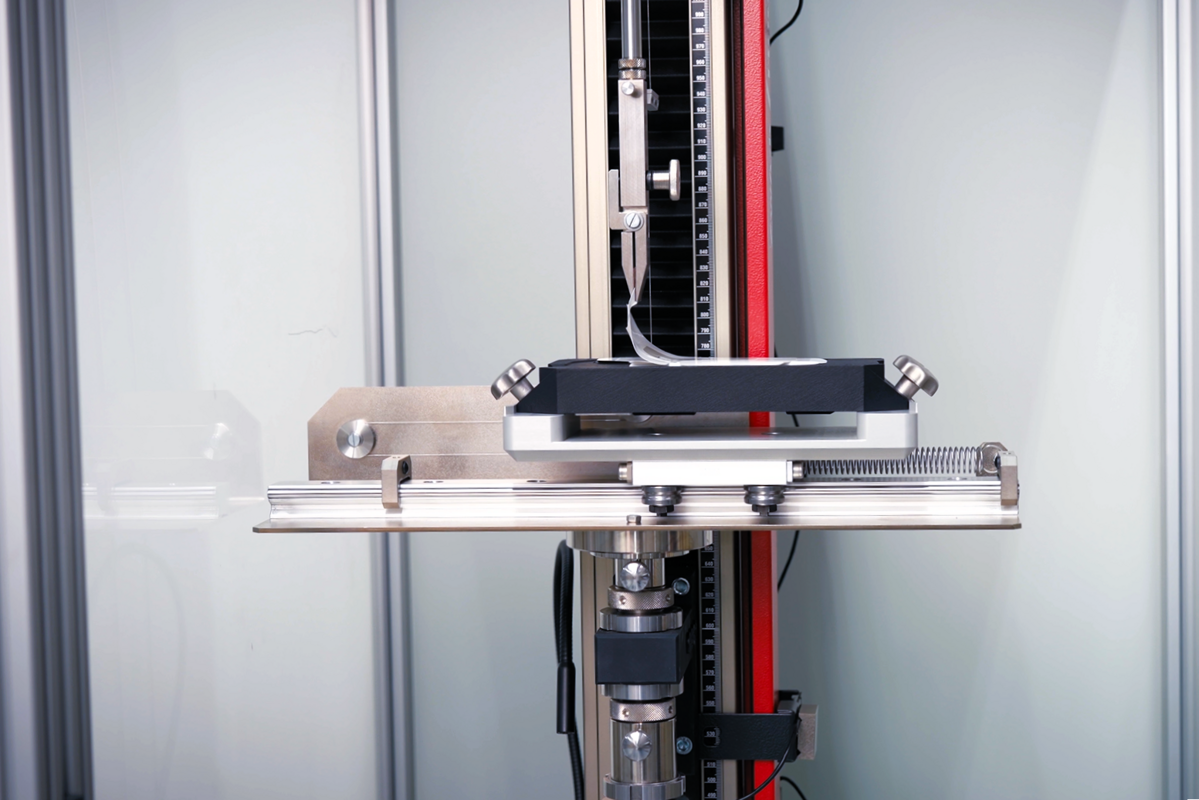
In addition to ensuring reliable drug delivery, the OBDS must also demonstrate secure adhesion to the skin. The second test area replicates the actual application procedure: First, the peel force of the protective film is determined, followed by the functional test. Both tests are performed on the same specimen without removing the OBDS test fixture. Thanks to a specially designed clamping device, the OBDS used can be easily transferred between the test areas without the need to reinsert or realign the specimen. The test parameters are loaded automatically into testXpert III, allowing for quick switching between tests.
- Function testing and adhesion force testing in a single testing machine
- No need to remove the OBDS test fixture
- Quick test changeover using testXpert III
- Testing on the same specimen is possible
Verified sensor performance before every test run with daily checks
During OBDS testing, all relevant sensors must function reliably. Optional daily checks verify the functionality and measurement accuracy of the sensors before the test run, covering force, weight, and injection depth as well as acoustics, camera systems, and color detection. If a sensor deviates from the defined target value, the start of the test is automatically prevented. This ensures that incorrect measurement results and incorrect approvals are avoided from the outset.
- Daily, cross-sensor verification
- Automatic lockout in the event of deviations
- Easy integration into routine testing procedures
- High measurement certainty and system availability


Audit-ready documentation with testXpert III
For OBDS tests in regulated environments, all test results must be documented completely, securely, and in a manner that is traceable at all times. The testXpert testing software supports requirements for data integrity, traceability, and audit-readiness. Test procedures and evaluations are conducted in a reproducible manner, and all actions relevant to the test are fully documented. User permissions, electronic signatures, and IT interfaces also facilitate compliance with regulatory requirements such as FDA 21 CFR Part 11.
- Automated and traceable test reports
- Compliance with FDA 21 CFR Part 11
- Audit trail for test-relevant changes
- Users, permissions, and signature management
- Integration with existing IT systems

Are you testing OBDS variants with different reservoir volumes, viscosities, signal profiles, or adhesive surfaces?
ZwickRoell helps you determine the appropriate test procedure, the right test fixture, and the necessary documentation at an early stage, from the test specification through to qualified routine operation.
Performing OBDS tests according to ISO 11608-6 with ZwickRoell
Info box: How the test is performed
An OBDS is positioned reproducibly in a special clamping device. In line with the actual application,peel force of the protective film is first determined in the upper test area. The clamping device, together with the specimen, is then moved to the functional test areawithout having to reinsert or realign the OBDS.
After the system is activated, the actuation force of the start button is measured. During the injection, the system detects acoustic signals such as start and end clicks as well as visual signals before, during, and after the administration. The injection depth is measured using a camera; injection time, injection volume, and injection profile are determined throughout the entire delivery process. In segmented dose delivery, individual boluses, including pauses or user-initiated interruptions, are documented separately. The entire process can be recorded on video with time synchronization. The results are used to evaluate dose accuracy, functional logic, user communication, adhesion properties, and reproducibility.


The ZwickRoell OBDS testing solution for ISO 11608-6 at a glance
The ZwickRoell OBDS testing solution is designed for sequential testing of wearable injection systems. It combines the relevant test values into a single system, thereby reducing the typical factors that can skew measurements when tests are conducted separately.
Key features:
- Complete capture of injection volume, time, and profile down to the last drop
- Precise testing for long injection times and high-viscosity medications
- Prevention of crystallization for reliable weighing results
- Testing of different OBDS variants using a single specimen
- Measurement of injection depth, actuation force, and acoustic and visual signals
- Second test area for determining peel force of the protective film and adhesive force
- Daily checks and traceable test results in accordance with FDA 21 CFR Part 11
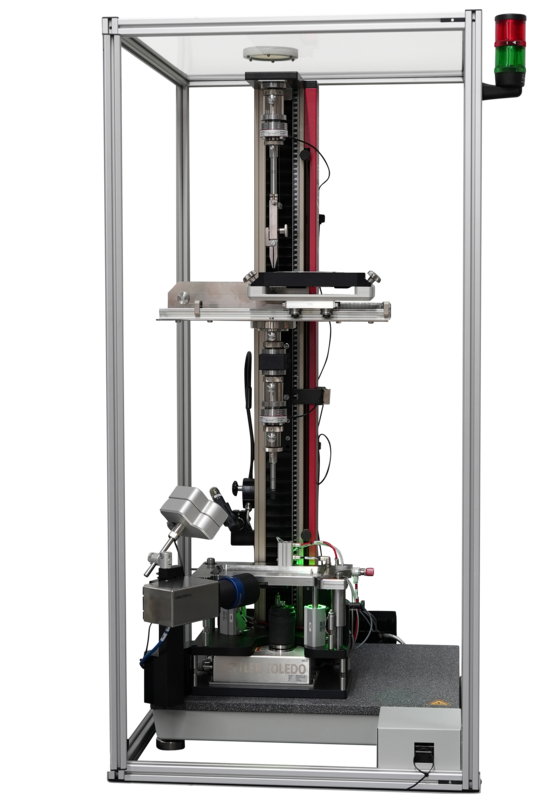
zwickiLine universal testing machine as the foundation for flexible OBDS testing:
The zwickiLine is ideally suited for testing in the low-force range and is used in research, development, and quality control. Thanks to its modular design, OBDS-specific test fixtures and a wide range of other testing tools can be adapted quickly and flexibly.
For medical and pharmaceutical applications, the zwickiLine is also available as a cleanroom-compatible testing machine . This means it can also be used in environments where defined cleanroom conditions are part of the testing process.
Partnering with Ypsomed to develop a unique OBDS testing solution
Our collaboration with well-known companies such as Ypsomed demonstrates our many years of experience in the medical and pharmaceutical sectors. Together, we developed a testing solution in accordance with ISO 11608-6 that integrates key requirements into a single system—including injection volume, injection time, injection depth, injection profile, and video recording. Tests conducted under conditions simulating body temperature (37 °C) and compliance with FDA 21 CFR Part 11 requirements are also taken into account.
Learn more about the development project with Ypsomed



FAQs about ISO 11608-6 and OBDS testing
An on-body delivery system (OBDS) is an autoinjector worn on the body. OBDS are designed for the delivery of highly viscous biologics and larger injection volumes. They are attached to the patient's skin and can administer medication over a longer period of time than handheld autoinjectors or other needle-based injection systems.
There are many names for on-body delivery systems: body-worn autoinjectors, wearable injectors, portable injection systems, bolus injectors, patch injectors and many more.
Testing in accordance with ISO 11608-6 is used whenever on-body delivery systems are being developed, quality-assured, or tested for the administration of medications. It supports both product development and routine testing in regulated environments.
Typical applications:
- Development of new OBDS to validate design, dose accuracy, and function
- Testing of high-viscosity medications and long injection times
- Quality assurance and quality control of relevant injection parameters
- Testing at pharmaceutical companies and CDMOs
- Verification of different OBDS variants in development and production environments
ISO 11608-6 specifies testing requirements for on-body delivery systems (OBDS). These include, among other things, dose accuracy, injection time, injection profile, injection depth, adhesive forces, as well as the evaluation of automatic functions and user signals. Together with the instructions for use (IFU) and the risk assessment, the standard forms the basis for the design of the test.
| Test value | Function |
|---|---|
| Actuation force | The force that the patient must exert to activate the OBDS. |
| Audible signals / Click times | Audible signals indicate the start and end of the injection to the patient. The timing of these signals, which are usually audible as a "click," is recorded. |
| Injection depth | The injection depth indicates the area of tissue into which the active ingredient is delivered. For an adhesive-wearable on-body delivery system (OBDS), it usually corresponds to the length of the visible needle. |
| Injection time | The injection time describes the total time of dose delivery or individual dose intervals. |
| Injection volume | The injection volume is the amount delivered during the injection time. |
| Injection profile | The injection profile compares the delivered injection volume to the injection time. |
| Adhesive strength of the adhesive surfaces | Both the peel force of the film and the adhesive force on the patient's skin are determined. See also ASTM D3330, ISO 4578, EN 1939 |
OBDS differ significantly from conventional autoinjectors or pens. They remain on the body during injection, often feature automatic functions, and communicate with the user via acoustic or visual signals. For this reason, these specific requirements are addressed separately in ISO 11608-6.
In addition to dose accuracy, injection depth, injection time, injection profile, actuation force, adhesive forces, and acoustic and visual signals all play an important role. Only by considering these test values together can a complete assessment of the device's function be made.


Interesting webinars on the topic


Downloads
- Industry brochure: medical industry PDF 6 MB
- Industry brochure: Testing Solutions for Injections Systems PDF 3 MB
- Product Information: Traceable and Reliable Test Results in Accordance with FDA 21 CFR Part 11 PDF 1 MB
- Product Information: Qualification of ZwickRoell Testing Systems PDF 1 MB
- Product information: zwickiLine Up to Fmax 5 kN PDF 820 KB
- Product Information: zwickiLine+ up to Fmax 2.5 kN PDF 873 KB
- Product information: zwickiLine in cleanrooms PDF 180 KB
