
ISO 7886-1: Glide force and leak testing of hypodermic syringes for single use
ISO 7886-1 defines requirements and test methods for sterile hypodermic single-use syringes for manual use. Annex E (breakaway and glide force) and Annex D (leakage testing with sideways force application) describe demanding mechanical test procedures that are critical to patient safety, injection comfort, regulatory approval, and batch release.
Manufacturers must demonstrate that plunger actuation forces remain within defined limits, that drug delivery is consistent and controlled, and that no leakage occurs even under unfavorable handling conditions. In practice, however, the requirements for the testing solution differ: Development focuses on iterative material and silicone optimization, as well as frequent specimen changes, while maintaining high reproducibility. Production prioritizes a stable, efficient series production process and scalability. Testing service providers, on the other hand, require maximum flexibility and cross-standard applicability of their testing systems.
ZwickRoell addresses these challenges with solution-oriented, scalable testing concepts that ensure reproducible results.
Challenges & sources of error Test procedure Testing solutions FAQs Downloads Free consultation

ISO 7886-1 in practice: Challenges and common sources of error in testing
- Limited flexibility of the standards-compliant test fixture:The test fixture specified in ISO 7886-1 for determining breakaway and glide force is not easily adaptable to other syringe types or cartridges. This particularly limits testing service providers, as investments are less flexible and additional systems may be required.
- Time constraints and operator influence during frequent specimen changes:Particularly with frequent specimen changes, for example during iterative material and silicone optimization in the development process, conventional fixtures reach their limits. Time-consuming specimen changes, such as manually loosening several screws, increase operator influence and make it more difficult to achieve reproducible test results.
- Series production requires, above all, stable, efficient, and scalable testing processes: As production volumes increase, reducing operator influence and ensuring consistent testing conditions become increasingly important.
- Distortion of measurement results due to clamping: A common measurement error in glide force testing is caused by radial preload. Even minimal, uneven clamping forces can deform plastic or glass syringes and alter the friction conditions in the syringe barrel. This results in distorted force curves and non-reproducible results.
- Error-prone force application and artificial force peaks: An imprecisely aligned force application can cause the plunger to tilt, realign itself, or rebound during testing. The resulting force peaks are test artifacts, distort the results, and can lead to incorrect assessments in quality assurance.

How ISO 7886-1 testing is performed:
Breakaway and glide force according to ISO 7886-1 Annex E:
- The syringe is first filled with water manually and connected to a specified needle via a 500 mm length of tubing.
- An axial compression test is then performed at a constant test speed of 100 mm/min, during which the breakaway force, maximum glide force, and average glide force are determined.
- The objective of the test is to evaluate the movement characteristics of the plunger and, consequently, the consistency and control of drug delivery, particularly with regard to friction, silicone lubrication (if present), and dose accuracy.
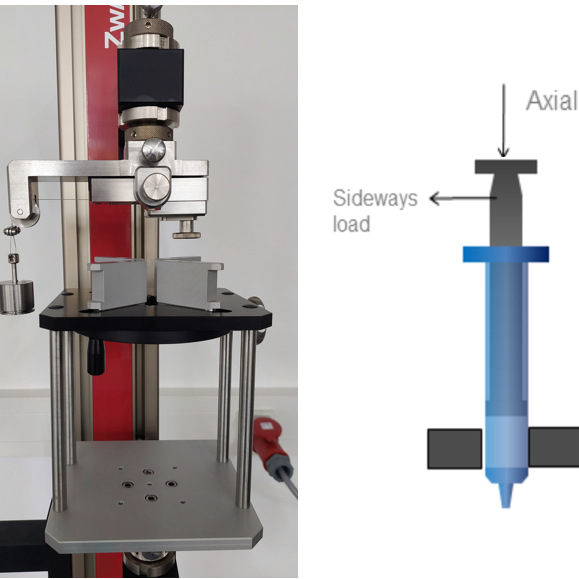
Liquid leakage testing with sideways force application according to ISO 7886-1 Annex D:
- The syringe is subjected to an internal pressure of 200 to 300 kPa under defined test conditions while a sideways force of 0.25 to 3 N is simultaneously applied to the plunger, intentionally deflecting it from its axis.
- During a 30–35 second hold time, the syringe is checked for pressure loss or visible leakage.
- The objective of the test is to assess the leak tightness of the syringe under realistic loading conditions and to identify critical leakage paths that can arise when force is applied at an angle during use.

Testing single-use syringes according to ISO 7886-1 with ZwickRoell: standard requirements vs. testing practice
In practice, reliable results are not solely determined by the standard itself, but also by how its requirements are implemented in the test setup. The challenge is to combine standards-compliant testing conditions with efficient handling and consistent reproducibility.
ISO 7886-1 illustrates only one example of a test fixture in Annex E. This fixture is not mandatory; compliance is determined solely by meeting the functional requirements of the test method and measurement process.
ZwickRoell solution: Universal syringe holder -Rethinking standards compliance
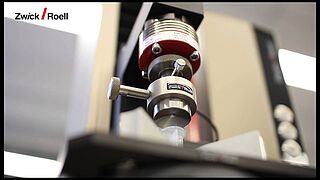
This is precisely where the universal syringe holder comes into play: It transforms the requirements of the standard into a practical, reproducible testing process, especially when testing varying syringe geometries and handling frequent specimen changes.
- Tool-free adjustment & quick-release mechanism:
The syringe diameter is defined once and remains consistently set for reproducible testing. The quick-release mechanism ensures that each specimen is automatically clamped under identical conditions, reducing operator influence and improving comparability. - Efficiency at high throughput:Time-consuming changeover procedures during specimen changes are eliminated, reducing testing time and minimizing sources of error in day-to-day testing operations.
Stress-free, secure gripping of a wide range of geometries
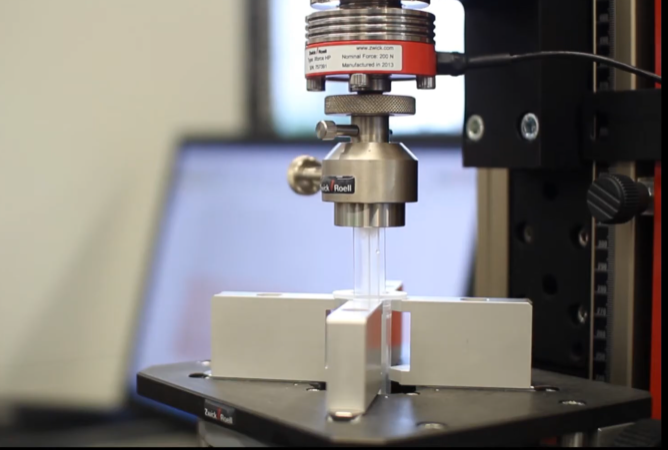
A key prerequisite for reliable measurement results is stress-free fixation of the syringe.
- Central clamping via four crosswise arranged contact points
- Precisely adjustable from 5 to 50 mm diameter via a handwheel
- Stress-free clamping with no overclamping or localized deformation
The friction conditions within the syringe barrel remain unchanged, and the measured forces accurately reflect the actual product behavior.
Stable force application for clean measurement curves
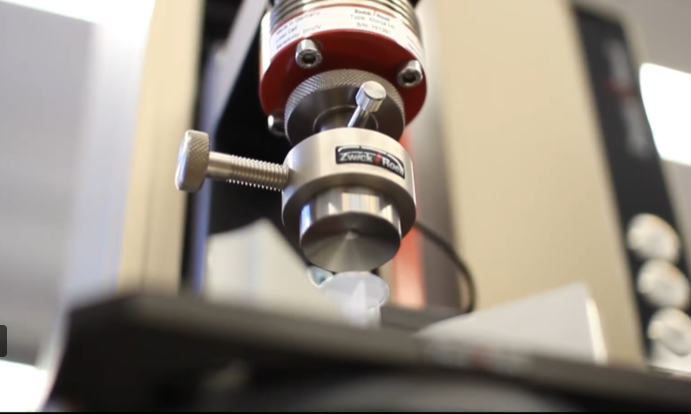
In addition to clamping, force application is a critical factor. When flat compression plates are used, even a slightly misaligned plunger can tilt, realign itself, or rebound during testing. The resulting force peaks are not a material property but rather test artifacts.
The universal syringe holder therefore utilizes a concave, self-centering compression plunger with a polished contact surface. The center of curvature coincides with the plunger head, automatically aligning and stabilizing it during loading. The inner curvature prevents abrupt movements upon contact and ensures consistent force transmission. The result is clean, interpretable force-displacement curves without artificial peaks.
Flexible use beyond the standard
The universal syringe holder is not only suitable for determining breakaway and glide forces according to ISO 7886-1, but can also be used across standards through adaptation, including for tests according to
- ISO 11040 (Prefilled syringes)
- ISO 11608-3 (Cartridges)
- ISO 8537 (Insulin syringes)
- ISO 11499 (Dental syringes)
- USP 382 (Stopper testing)
A single solution for different testing scenarios in development, quality assurance, and testing services.

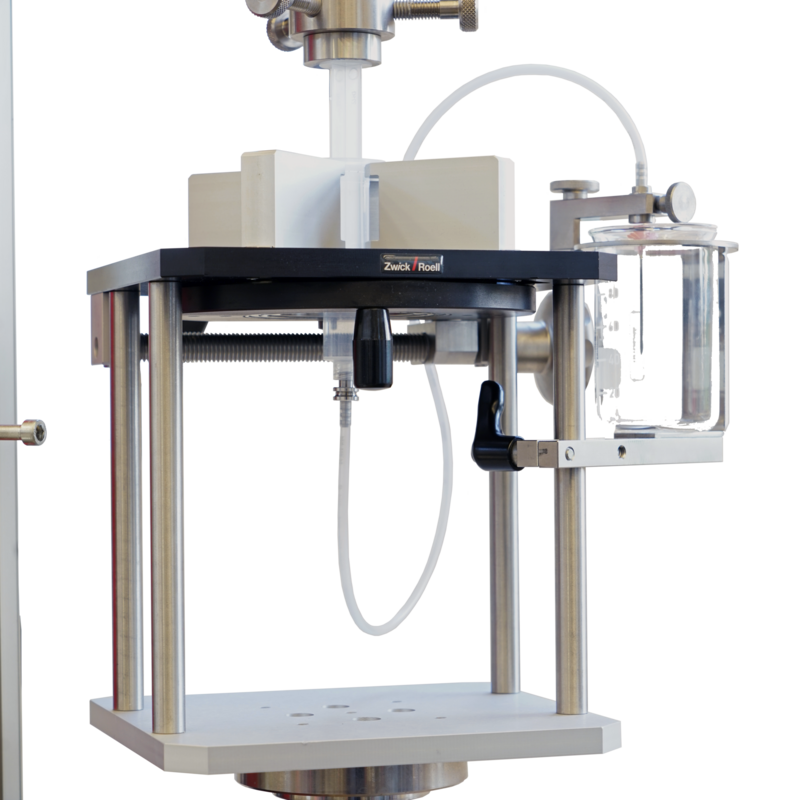
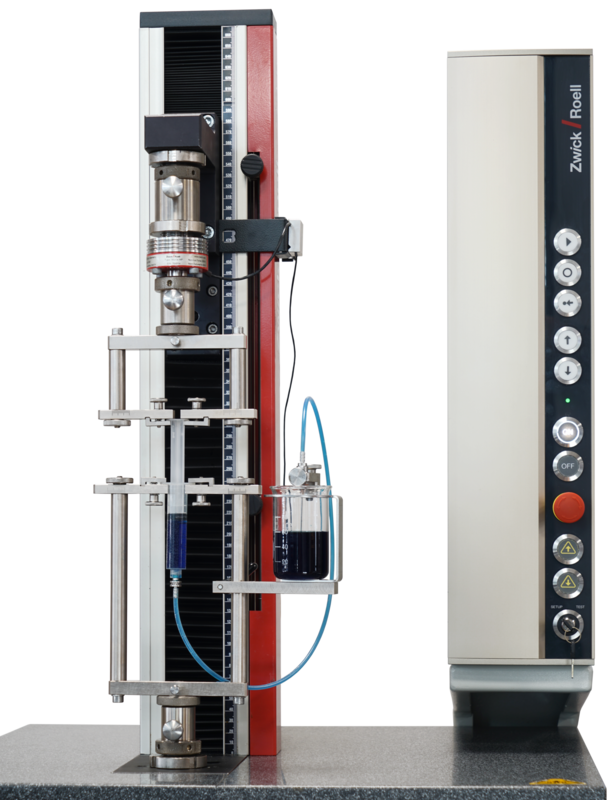
Test fixture for plunger actuation force according to ISO 7886-1
For applications where a test fixture is required to exactly match the design shown in the standard, ZwickRoell offers a standards-compliant test fixture for determining plunger actuation force according to ISO 7886-1. Its design is based on the solution shown in Annex E and it meets all normative requirements.
This variant is particularly suitable for testing applications where, in addition to compressive loading, a tensile force must also be applied to the plunger. The upper and lower clamping fixtures allow syringes with diameters from 6 to 33 mm to be securely fixed in accordance with the standard, while the test setup, including tubing, a cannula, and a fluid reservoir, is integrated in a standards-compliant manner.
This solution also ensures:
- Standards-compliant test conditions
- High measurement accuracy
- Reproducible force-displacement curves
- Reliable and traceable test results in accordance with FDA 21 CFR Part 11
Higher throughput, less operator influence – Scalable testing systems for syringes
While flexibility and product variety are the primary focus in development, large-batch syringe production requires a time- and resource-efficient testing process. As production volumes increase, scalability, process stability, and reduced operator influence become increasingly important.
ZwickRoell offers solutions for various levels of automation, from serial and parallel testing stations and X-Y table setups to automated handling systems. This allows the testing of breakaway force, glide force, and leak tightness requirements to be precisely adapted to throughput, the production environment, and quality strategy.



Parallel testing of syringes


Do you want to design your syringe testing for higher production volumes or reduce operator influence?
Together we will analyze your current testing process and show you how breakaway force, glide force, and leak-tightness testing according to ISO 7886-1 can be scaled efficiently, from a standalone testing station to a fully automated solution.
Request a free consultation today

FDA 21 CFR Part 11 – Security and confidence in injection system testing
The medical and pharmaceutical industries are subject to particularly stringent requirements for the traceability, security, and integrity of test data. FDA regulation 21 CFR Part 11 governs the conditions under which electronic records and electronic signatures may replace paper-based documentation. The goal is to ensure that digital test data is trustworthy, tamper-proof, and traceable at all times —and thus legally equivalent to paper documents.
ZwickRoell supports you in complying with these requirements with testXpert III testing software and the traceability option. All test-relevant actions and changes are automatically logged in an audit trail, stored in a tamper-evident manner, and can be retrieved in a readable format when required. Electronic signatures provide clear accountability and enable efficient, paperless documentation. The scope and depth of logging can be flexibly tailored to your internal QA requirements.
In addition, ZwickRoell supports you with qualification services (DQ / IQ / OQ) for the validation of your testing systems. This creates the technical and organizational foundation for conducting compliant, efficient, and audit-proof testing of injection systems – in accordance with FDA 21 CFR Part 11 and the expectations of a regulated environment.
FAQs
Proper glide force of the syringe plunger is imperative for continuous delivery of the intended drug. One determining factor of the glide force is the condition of the silicone lubricant that lines the inside of the syringe barrel. If the barrel is not properly lubricated, or the silicone oil has begun to dry throughout the shelf-life of the injector—a condition that can be simulated for testing purposes—the plunger may be subjected to an initial breakaway force that is significantly larger than the subsequent glide force and become unable to glide at the speed and with the continuity the standard requires.
In syringe development, optimal siliconization is evaluated by comparing breakaway and glide forces. Fast, reproducible specimen changes and stable test conditions provided by the ZwickRoell universal syringe holder ensure that differences can be reliably attributed to material and coating variants.
For single-use syringes, the syringe is manually filled with water before testing. A 500 mm long tube with an inner diameter of 2.7 mm and a needle (18 G=1.2 mm diameter) is connected to the end of the syringe cone. A pure compression test is performed with a test speed of 100 mm/min. The breakaway force, maximum force, and average glide force must be determined.
The standard contains general requirements in the form of design guidelines for manufacturers. The specified force limits have proven effective in practice over many years.
| Syringe filling volume (V) [ml] | Breakaway force (FS) [N] max. | Glide force (F) [N] max. | Maximum force (Fmax) [N] |
|---|---|---|---|
| V < 2 | 10 | 5 | < (2.0 x F) or (F + 1.5 N) higher values relevant |
| 2 ≤ V < 50 | 25 | 10 | < (2.0 x F) or (F + 1.5 N) higher values relevant |
| 50 ≤ V | 30 | 15 | < (2.0 x F) or (F + 1.5 N) higher values relevant |
The leakage test according to ISO 7886-1 Annex D examines whether a syringe remains leak-tight when a sideways force is applied to the plunger stopper. In real-world use, force is rarely applied purely axially. Handling inevitably introduces transverse forces. Sideways force testing therefore simulates the most critical leak-tightness scenario: The plunger is deflected by a defined amount, causing the stopper to tilt within the barrel. As a result, the effective sealing area is reduced and a potential leakage path may develop.
When the plunger is misaligned, the stopper partially loses surface contact with the barrel wall. This realistic use scenario is precisely what the test is designed to evaluate.
The standard defines clear parameters:
- Sideways force of 0.25–3 N combined with an axial internal pressure of 200–300 kPa
- Constant hold time of 30–35 seconds
- Assessment of leak-tightness based on pressure loss or visual inspection for visible leakage.


Downloads
- Industry Brochure: medical industry PDF 6 MB
- Industry brochure: Testing Solutions for Injections Systems PDF 3 MB
- Product Information: Test Fixture for Determining Breakaway Force and Glide Force PDF 343 KB
- Product Information: Fixture for testing syringe plunger force PDF 595 KB
- Product Information: Traceable and Reliable Test Results in Accordance with FDA 21 CFR Part 11 PDF 1 MB
- Product Information: Qualification of ZwickRoell Testing Systems PDF 1 MB
