
ISO 11608-3 Testing of Cartridges
ISO 11608-3 is the key standard for testing cartridges and other drug containers used in injection systems such as pens and autoinjectors. The focus is on the forces exerted on the stopper, leak tightness, and functionality during drug delivery.
In practice, however, testing is susceptible to influences such as specimen handling or test setup – factors that can distort test results. ZwickRoell specifically addresses these challenges through reproducible test conditions and standards-compliant, flexible testing solutions.
Challenges & sources of error Test procedure Testing solution Automation FAQs Downloads Request a consultation
Key points
- ISO 11608-3 requires, among other things, tests to determine the breakaway force and glide force of the stopper, leakage and leak tightness tests for resealing, and functional tests for dose and volume accuracy. This ensures that the drug container functions reliably, remains leak-tight, and delivers consistent performance from the first dose to the last.
- Critical influencing factors include siliconization, material combinations, and the tribological system formed by the barrel, stopper, and lubrication.
- Common errors do not originate in the product, rather in the test setup, e.g. due to clamping forces on the cartridge or wobbly cartridges in the holder.
- Even minimal lateral forces can significantly distort glide force measurements.
- Conventional holder solutions are often not sufficiently reproducible because they do not ensure defined specimen guidance.
- ZwickRoell enables stable, standard-compliant testing conditions with reproducible specimen guidance and reduced operator influence.
The standard in practice: Sources of error & their influence on test results
- Influence of material and system properties: The siliconization of the inner wall significantly influences the glide force and thus the friction conditions within the system. Aging, uneven lubricant distribution, and the combination of stopper material, barrel material, and lubrication can lead to increased breakaway forces and significantly altered force curves.
- Critical factor - specimen handling and clamping: Since cartridges lack a finger flange, defined and reproducible fixation is particularly challenging. Lateral clamping forces or excessive clamping can influence the internal friction behavior and alter the measured glide force, even in glass cartridges. This can result in inaccurate force values, apparent limit violations, and non-reproducible results.
- Problem with inaccurate holder solutions: Simple sleeve-type fixtures (cartridge holders) are often designed around the maximum diameter specified by the standard and therefore and do not adequately reflect real-world tolerances. If cartridges are smaller than this maximum value, play develops in the holder, causing the specimen to wobble or tilt during testing.
This can result in altered force-displacement curves, unstable measurement signals, and limited comparability of results. - Source of error – Force application: An unsuitable force applicator can distort force transmission and lead to deviations in the force curve. The force applicator diameter must be selected so that the stopper is subjected to a defined load without being locally deformed or colliding with the cartridge.
- Challenges in leak tightness and leakage testing: Leaks can occur at the cap and septum as well as at the contact between the stopper and barrel, and are particularly difficult to detect using force measurement alone, especially in the case of small leaks. Since fluid is virtually incompressible, the pressure is transferred to the rubber stopper, which can deform in a balloon-like manner under load. This creates the risk that microleaks will remain undetected or that safety-relevant effects will only become apparent upon failure.

How ISO 11608-3 testing is performed:
ISO 11608-3 covers several testing areas:
- First, the breakaway force and glide force of the stopper are determined by means of a compression test on a cartridge with the cap and septum removed, using a defined test speed (e.g., 50 mm/min). Maximum limit values are then evaluated.
- Leak tightness tests are then performed, in which the filled and sealed cartridge or liquid container is pressurized to detect leaks through pressure loss and visual inspection. To assess resealability, the stopper is punctured multiple times and subsequently tested under pressure again.

Cartridge testing to ISO 11608-3 with ZwickRoell
With the zwickiLine universal testing machine and universal syringe holder, ZwickRoell offers a flexible testing solution for syringes, cartridges, and similar dosing devices. It is suitable for determining breakaway and glide forces, as well as for leakage and dose accuracy testsin accordance with numerous international standards.
The adjustable cartridge adapter, whose inner diameter can be precisely adapted to the respective cartridge diameter, guides the cartridge in a defined manner, without wobbling or tilting, and without introducing additional clamping forces. Compared to conventional plastic holders with a hole, this improves the reproducibility of the test arrangement and the comparability of the force-displacement curves.
The four opposing contact points of the universal syringe holder, combined with the precisely adjustable diameter, enable reproducible, low-force positioning of the cartridge adapter, thereby supporting stable test conditions for glide force and leak tightness testing.
In addition, the universal syringe holder features a lower support surface for accommodating a beakerused to capture the expelled liquid. An optional scale can be integrated to weigh the dispensed volume and ensure complete emptying.
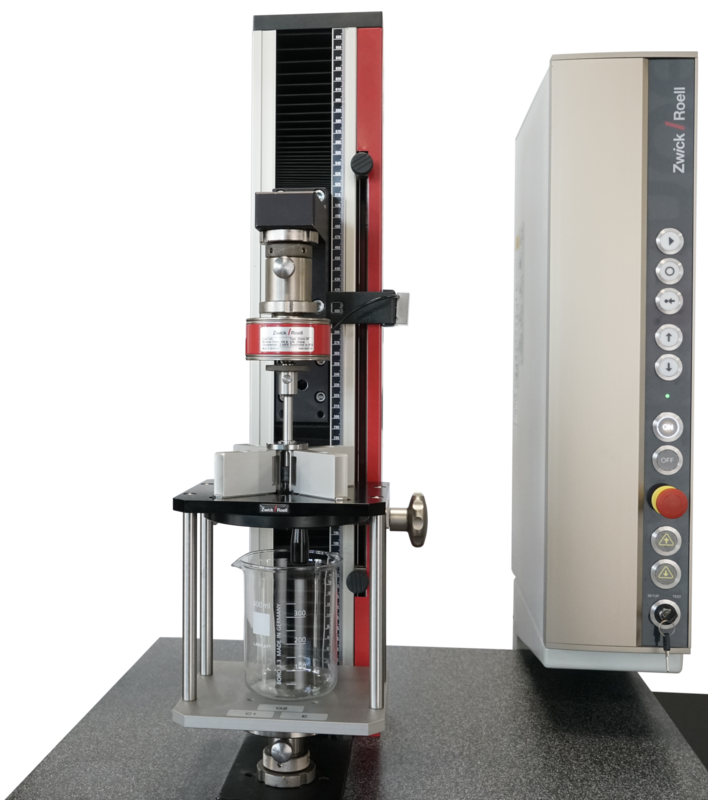


Video for plunger glide force on syringes to ISO 7886-1
The universal syringe holder is not only suitable for ISO 11608-3, but can also be used across standards, including for testing according to:
- ISO 11040 (Prefilled syringes)
- ISO 7886-1 (Single-use syringes)
- ISO 8537 (Insulin syringes)
- ISO 11499 (Dental syringes)
- USP 382 and 1382 (Based on ISO 11608-3, the requirements on functional proficiency tests for breakaway force, glide force, and leak tightness are described here.)
A single solution for different testing scenarios in development, quality assurance, and testing services.


Automated cartridge testing to ISO 11608-3
For reproducible testing of cartridges according to ISO 11608-3, ZwickRoell offers automated testing solutions for determining breakaway and glide forces as well as leak tightness using X-Y table setups. These enable sequential testing of up to 64 cartridges with reduced operator influence, high repeatability, and increased throughput – ideal for quality assurance, development, and validatable testing processes.

Fully automated cartridge testing with specimen handling system
The roboTest N automates all the steps that are time-consuming and prone to error in manual testing. A single magazine load typically allows up to 30 insulin pens or pen injectors to be tested automatically. With automated magazine changes, up to 150 pens per automated run can be tested without operator intervention, making the process highly reproducible and compliant with ISO 11608.
Part 2 of the following video shows the automated testing of the breakaway and glide force on cartridges.
The mobile docking system allows switching to manual test mode at any time.


Use Cases – Typical application areas
ISO 11608-3 is primarily used in the development and quality assurance of drug delivery systems:
- Development of new cartridge and stopper materials
- Evaluation of siliconization processes
- Comparison of different material combinations
- Quality assurance of series production
- Testing of injection systems (pens, autoinjectors)
ISO 11608-3 Cartridge testing FAQs
A cartridge is a glass barrel equipped with a pierceable membrane (septum), a sealing cap, and a rubber stopper, filled with parenteral medicinal products and used in injection systems.

Typical test requirements of ISO 11608-3 are:
- Forces for initiating and maintaining the stopper movement (breakaway and glide force)
- Leakage and leak tightness tests
- Resealability after multiple punctures
- Dose accuracy and dispensed volume
- Accuracy of the last dose
The breakaway and glide force of the syringe plunger or cartridge stopper determine the consistency of drug delivery. A key influencing factor is the condition of the silicone film on the inner wall of the barrel. Aging or uneven siliconization can lead to increased breakaway forces that are significantly higher than the subsequent glide force.
Syringes and cartridges must be tightly sealed on both ends. Leakage can occur both at the cover cap and between the stopper and the barrel wall – especially under high axial load.
ISO 11608-3 therefore requires leak tightness testing of all containers and fluid pathways.
As part of the resealability test, the closure stopper is pierced multiple times with a needle. A defined force, derived from the inner diameter of the cartridge (F = 0.106 N/mm² x d²), is then applied for 60 seconds. The evaluation is performed visually and using blotting paper.
Originally conceived as a standard solely for cartridges, ISO 11608-3 has been expanded over time. Today, it permits the testing of various drug containers, including syringes and prefilled containers. In practice, however, the focus remains predominantly on the testing of cartridges, which is still described in detail in a separate annex to the standard.
To determine the breakaway and glide forces on cartridges, a compression test is performed at a test speed of 50 mm/min after removal of the closure and liquid. The permissible limits are:
- Breakaway force: max. 15 N
- Glide force: max. 10 N


- Product Information: Test Fixture for Determining Breakaway Force and Glide Force PDF 343 KB
- Industry brochure: Testing Solutions for Injections Systems PDF 3 MB
- Product Information: Traceable and Reliable Test Results in Accordance with FDA 21 CFR Part 11 PDF 1 MB
- Product Information: Qualification of ZwickRoell Testing Systems PDF 1 MB
- Industry Brochure: medical industry PDF 6 MB

