
Testing of pen injectors and insulin pens
Pen injectors – particularly insulin pens – are subject to clearly defined requirements of the international standard series ISO 11608. In practice, however, manufacturers face the challenge of implementing these requirements under realistic conditions due to limited access to the final medication, increasing product variety, high production cycles, and the demand for reproducible, audit-proof measurement results.
ZwickRoell combines standards-compliant testing technology according to ISO 11608-1 to -3 with practical test strategies – from mechanical function testing without active ingredients and spring simulations in pen development to fully automated life cycle testing and test strategies for networked medical devices (pens with connectivity modules). This enables reliable, efficient, and future-proof testing of pen injectors.
ISO 11608 Part 1-3 Pen testing without medication Pen testing with virtual spring Testing of pens with connectivity module Automated pen testing Life cycle test with priming Qualification service Free consultation

How are pen injectors tested?
It is important to follow the instruction for use (IFU) when using a pen, since normally a new needle has to be screwed on for each injection. In most cases, the air bubble contained in the cartridge must be moved towards the needle by tapping it while in an upright position. Priming is then usually necessary before the injection, which involves injecting into the air with the minimum dose setting until liquid emerges from the needle tip.
The scope of the tests varies, depending on whether they are intended for design validation or within the framework of quality testing. The international standard series ISO 11608 primarily describes the requirements for design validation. It is always necessary to assess the testing requirements within the scope of risk management.
The relevant parts of the standard ISO 11608, parts 1 to 3, describe the required tests on the pen and its components in detail:
- ISO 11608-1 – Dose accuracy & functional stability: Specifies the primary requirements for a pen: accurate dose delivery, functional stability, actuation force, and mechanical robustness.
- ISO 11608-2 – Pen needles: Regulates the compatibility between needle and pen, e.g. through tensile testing of the pen needle system, needle unscrewing torque including dose accuracy and confirmation of liquid delivery
- ISO 11608-3 – Cartridges and other drug containers: Focuses on liquid-carrying components by determining breakaway and glide forces, leak tightness and resealability, as well as force tests on the stopper


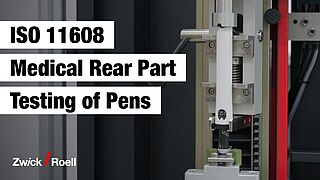
Function tester for pen mechanics (pen testing without medication)
The function tester for pen mechanics enables targeted testing of the mechanical drive system of pens and autoinjectors, without a cartridge and without medication.
Background: Device manufacturers often lack access to the final drug during early development phases or series production, as it is reserved for the pharmaceutical manufacturer or only available in limited quantities. Furthermore, drug-based testing would be complex, costly, and subject to regulatory requirements.
To enable a reliable and standards-compliant assessment, only the purely mechanical drive component of the pen is tested. The function tester measures the plunger rod travel during dose delivery. Since the delivered volume can be calculated directly from the plunger movement and the known cross-sectional area, the dose accuracy can be demonstrated indirectly yet reproducibly and with high precision, entirely without the active ingredient.
The function tester is primarily used by plastics and device manufacturers for final inspection after assembly, as well as in research and development to determine the service life of reusable pen systems.


Testing pens with a virtual spring – Realistic simulation without physical springs
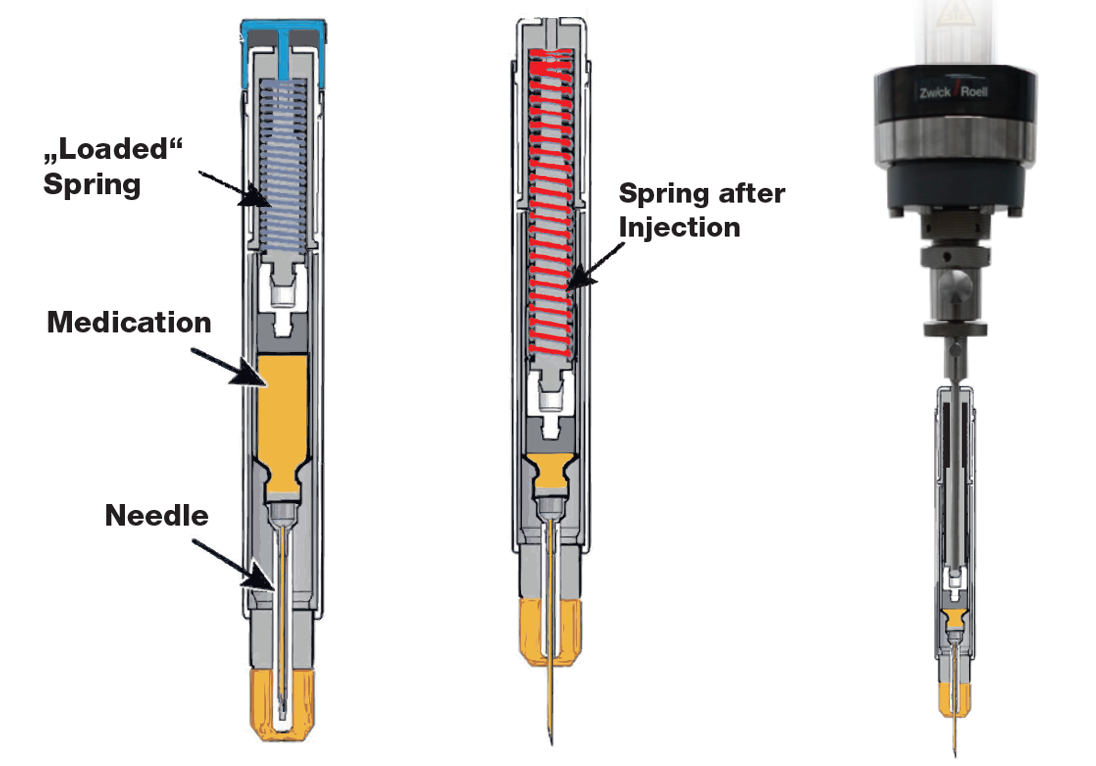
In modern spring-loaded pens and autoinjectors, the spring characteristics play a crucial role in ensuring the safe activation of the injection process. Particularly with highly viscous biologics or after prolonged storage – when the viscosity of the drug increases – it must be ensured that the breakaway and glide force of the system remains sufficient to carry out the injection completely and reliably.
With its virtual spring simulation, ZwickRoell offers an innovative testing method that completely eliminates the need for real springs. It is particularly useful in autoinjector and pen development, as well as in prospective aging tests.
Virtual spring instead of physical mechanics
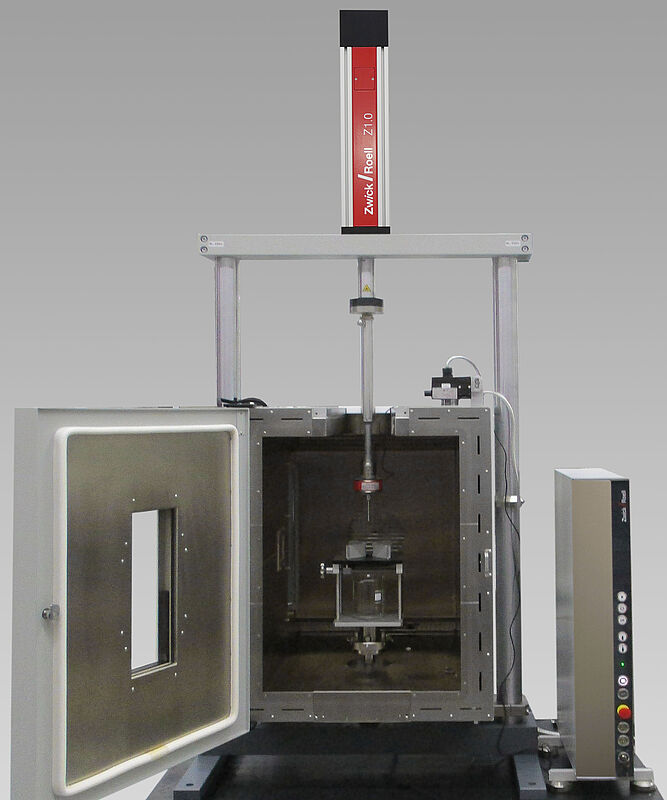
Rather than using numerous physical springs, testXpert software simulates the spring's behavior. The desired spring characteristic is defined directly in the software – for example, stiffer, softer, or more progressive – and the testing machine follows the resulting force-displacement curve (spring curve) in a force-controlled manner. An optional temperature chamber allows for the simulation of spring forces under temperature.
This allows for the flexible, reproducible simulation of a wide variety of spring characteristics without mechanical modification.
Advantages at a glance
- No physical springs required – no replacement, no inventory stocking, reduced development effort
- Flexible simulation of spring characteristics via software for rapid adjustments and comparative studies
- Reproducible, standards-oriented test conditions from the earliest stages of development
- Early assurance of functionality, even when viscosity changes after storage
- Reduced development and testing costs with increased efficiency and product safety
Testing of networked medical devices – mechanics meets data integrity
More and more medical devices – from insulin pens and autoinjectors to inhalers and smart medication boxes – feature integrated electronics and connectivity modules. Using technologies such as Bluetooth Low Energy (BLE), NFC, or Wi-Fi, they transmit usage data to apps or clinical information systems. This data informs dosage recommendations, documents treatment progress, and supports both patients and medical personnel.
This increases the responsibility of manufacturers: Mechanical function and digital data transmission must be perfectly integrated.
Especially with insulin pens, which transmit patient-critical information, incorrect or delayed data can have serious consequences.
ZwickRoell tests networked medical devices by combining mechanical function testing and digital data transmission in an integrated test process. While the device performs its typical mechanical movements—such as dispensing a dose, releasing the cap, or simulating an injection—the data transmitted by the product via Bluetooth, NFC, or Wi-Fi is simultaneously captured, decoded, and analyzed. This allows the measured physical values to be directly compared with the transmitted digital information, such as dosage amounts, timestamps, or event markers.
This process not only verifies whether a signal was transmitted, but also assesses the reliability of the transmission. Latency, dropouts, corrupted packets, and delays are analyzed, as well as the software response of the connected app or cloud platform. Complementary hardware modules and software tools enable complete documentation, including timestamps, log files, and – if required – synchronized video recording.
This results in a comprehensive assessment that evaluates both the mechanical performance of the medical device and the integrity, accuracy, and security of the transmitted data. This combined approach ensures that networked devices function reliably under real-world conditions and meet the stringent regulatory requirements for data quality, traceability, and patient safety.


Fully automated (insulin) pen testing with roboTest N
With the robot-assisted testing system roboTest N and a testing machine with torsion drive, ZwickRoell offers a comprehensive, fully automated solution for the efficient and reproducible testing of all common pen types – from standard pen injectors to insulin pens in life cycle testing.
The roboTest N automates all the steps that are time-consuming and prone to error in manual testing. A single magazine load typically allows up to 30 insulin pens or pen injectors to be tested automatically. With automated magazine changes, up to 150 pens per automated run can be tested without operator intervention, making the process highly reproducible and compliant with ISO 11608:
- Automatic insertion of the pen into the testing machine
- Removal of the inner and outer needle shield cap (cap and housing removal) using pneumatic grippers and automatic collection of all caps in an integrated container
- Fully automated process for mechanical function tests. These can be performed both with and without inserted cartridges (rear part testing).
- Optical dose detection using a video camera (e.g., digit recognition of the dosing window)
- Dose accuracy test with exact volume or weight verification
- Breakaway and glide force testing
- Automated sorting back into the tray
The mobile docking system allows switching to manual test mode at any time.
You can also add a priming station to the automated testing system, with which the air bubble can be removed and the pen can be primed right before the test.

Automated life cycle testing of pen injectors with integrated priming station
Pen injectors – especially insulin pens – must reliably maintain their functionality over hundreds to thousands of cycles. This is precisely where automated life cycle testing with the roboTest N, enhanced by a priming station, comes in. It replaces all manual preparation steps with a fully automated sequence – compliant with ISO 11608, highly precise, and completely without operator intervention.
The integrated priming station – the heart of the automated pen life cycle test
The priming station solves one of the biggest problems of automated pen testing: insufficient priming leads to dried medication residue and clogged needles.
With the new priming station, all previously manual steps (removing the cap, screwing on the needle, shaking the pen, dispensing several units for priming) are performed automatically and immediately before the test – exactly as the patient or medical staff would do.
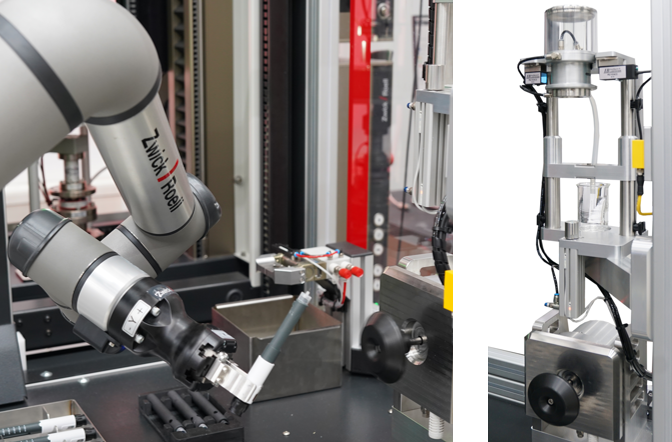
Here's how automatic priming works in detail:
- Dose presetting: The pen is set to two units in the testing device.
- Shaking: The robot takes the pen to a vibration station that removes air bubbles.
- Vertical positioning: The pen is placed with the needle pointing upwards.
- Priming trigger: Pneumatic gripper actuates the dose knob.
- Fluid detection: A light barrier precisely detects when medication exits the injector.
- Collection beaker: The drop is collected in a small beaker.
This makes it possible to reproduce true life-cycle behavior.

ZwickRoell qualification service DQ · IQ · OQ – Assurance Through Validated Testing Systems
In the regulated environment of the medical technology and pharmaceutical industries, the qualification of testing systems is a key component of quality assurance. Legal requirements and international guidelines such as GMP (Good Manufacturing Practice) and GAMP (Good Automated Manufacturing Practice) mandate that all test-relevant equipment and computerized systems are traceably documented, evaluated, and verified throughout their entire lifecycle. The goal is to minimize risks and ensure patient safety at all times.
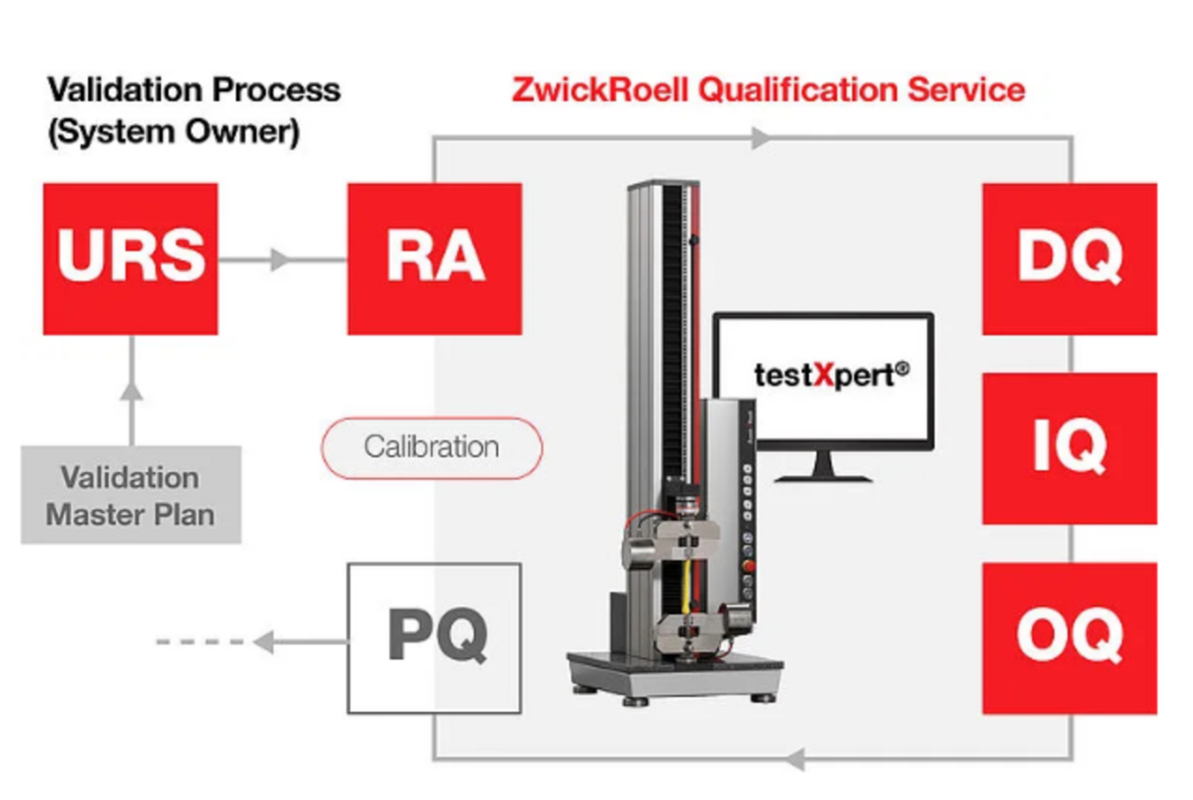
With the ZwickRoell DQ/IQ/OQ qualification service, you receive structured, field-proven support for precisely this task. The process begins with a system-specific specification that supports you in preparing your URS (User Requirements Specification). Building on this, an RA (risk analysis) is conducted, in which all GMP and safety-relevant requirements are evaluated and consistently mapped throughout the entire qualification process.
ZwickRoell supports you from design qualification (DQ) through installation qualification (IQ) to operational qualification (OQ) – with modular, audit-proven documentation packages that can be flexibly adapted to your requirements. Experienced and specially trained ZwickRoell experts efficiently conduct the qualification on-site at your facility – for both new and existing testing systems. This creates a solid foundation for audits and ensures that your injection system tests are compliant, reproducible, and audit-proof.


- Industry Brochure: medical industry PDF 6 MB
- Industry brochure: Testing Solutions for Injections Systems PDF 3 MB
- Product Information: Test Fixture for Determining Breakaway Force and Glide Force PDF 343 KB
- Product Information: Function Tester for Pen Mechanics PDF 3 MB
- Product Information: Spring simulation (virtual springs) PDF 684 KB
- Product Information: Compartment magazine for roboTest N automation PDF 636 KB
- Product Information: Traceable and Reliable Test Results in Accordance with FDA 21 CFR Part 11 PDF 1 MB
- Product Information: Qualification of ZwickRoell Testing Systems PDF 1 MB


